Train Wrecks & Airplane Crashes — original historical photographs
Historical narratives based on Oregon County History: Train Wrecks and Plane Crashes, by Marge Shipp, Jenny Underwood and Max Evans, with photography and research by Lindan Shann Caldwell and art by Anita Jones Caldwell.
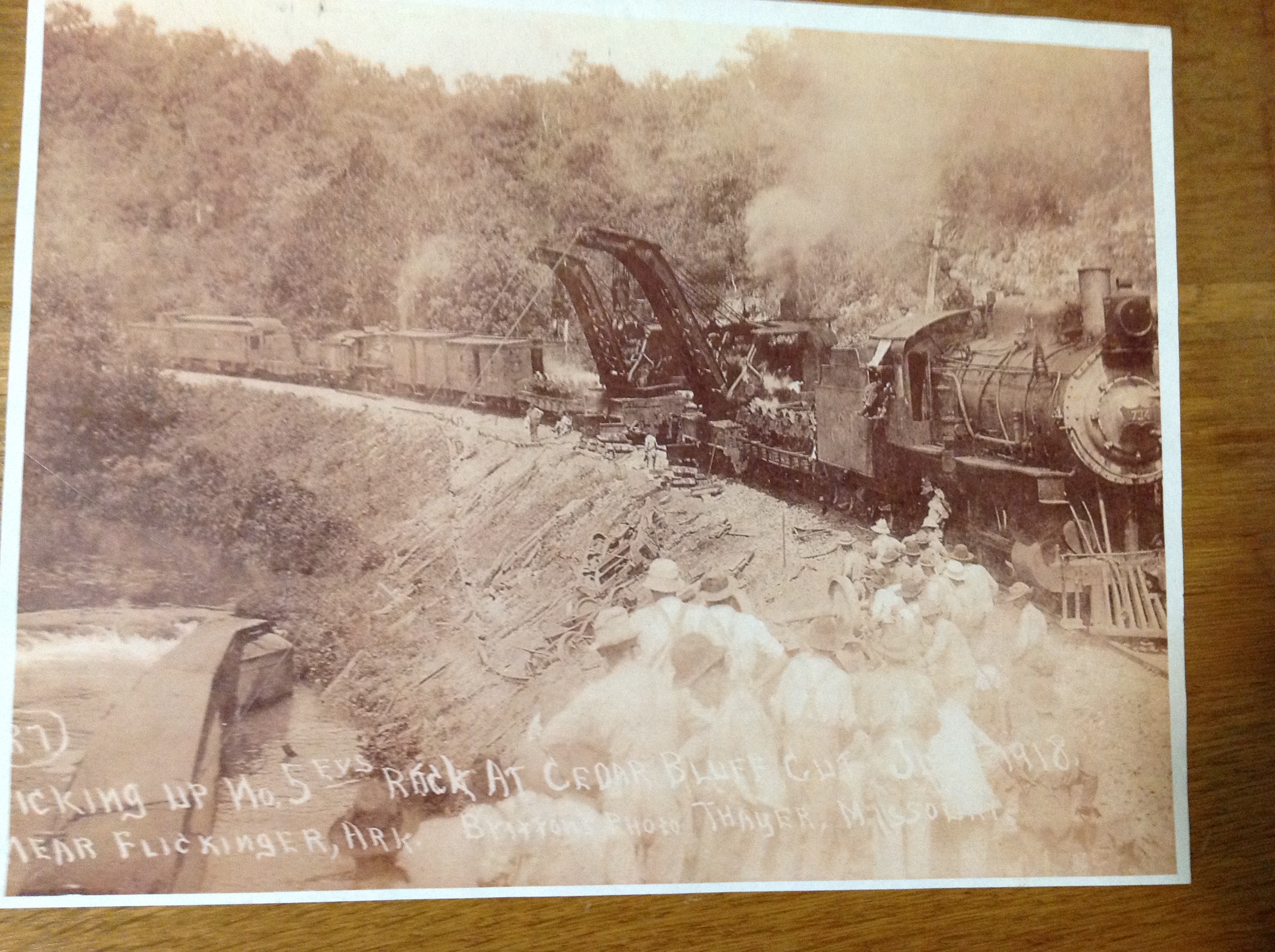
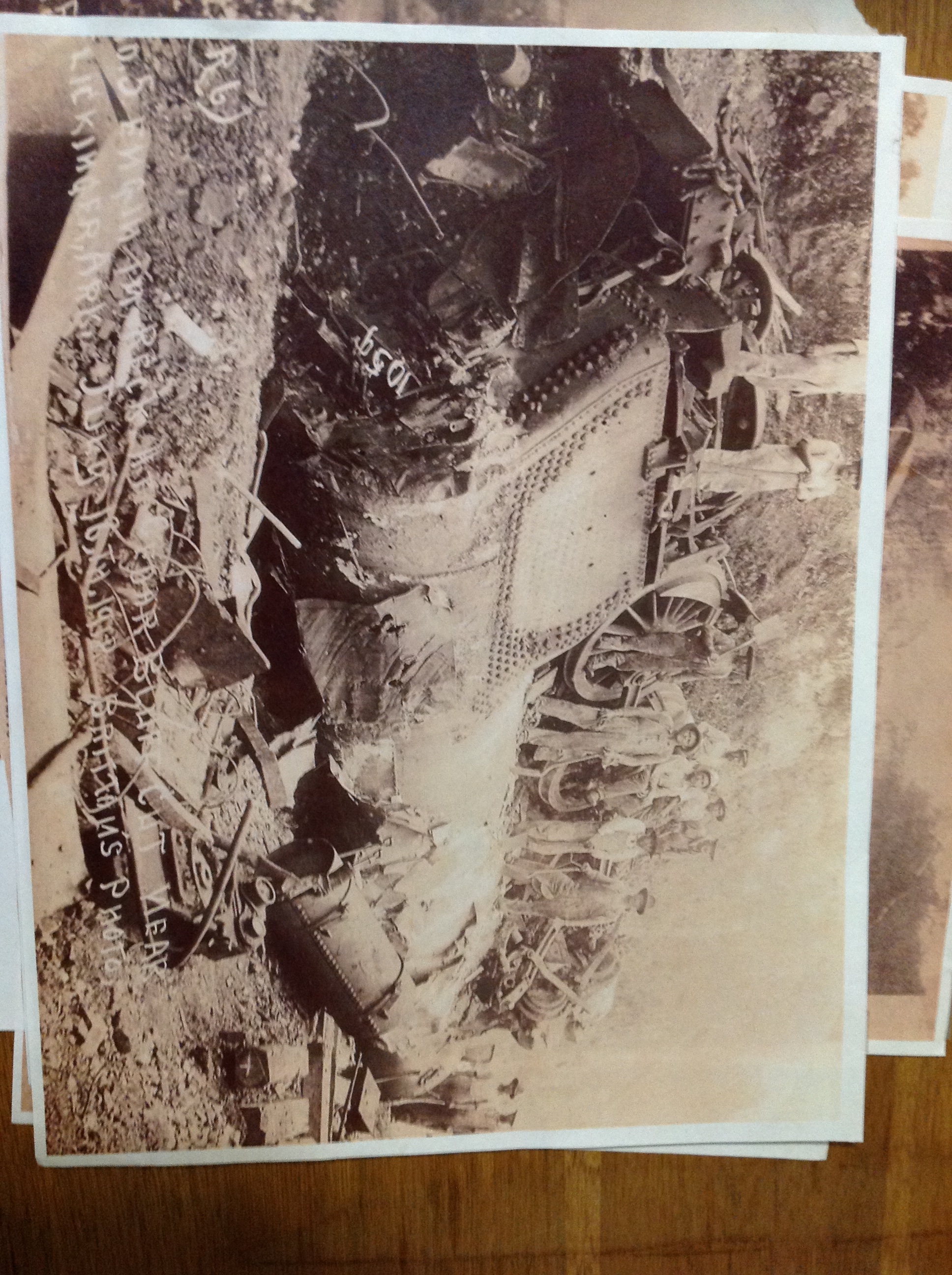
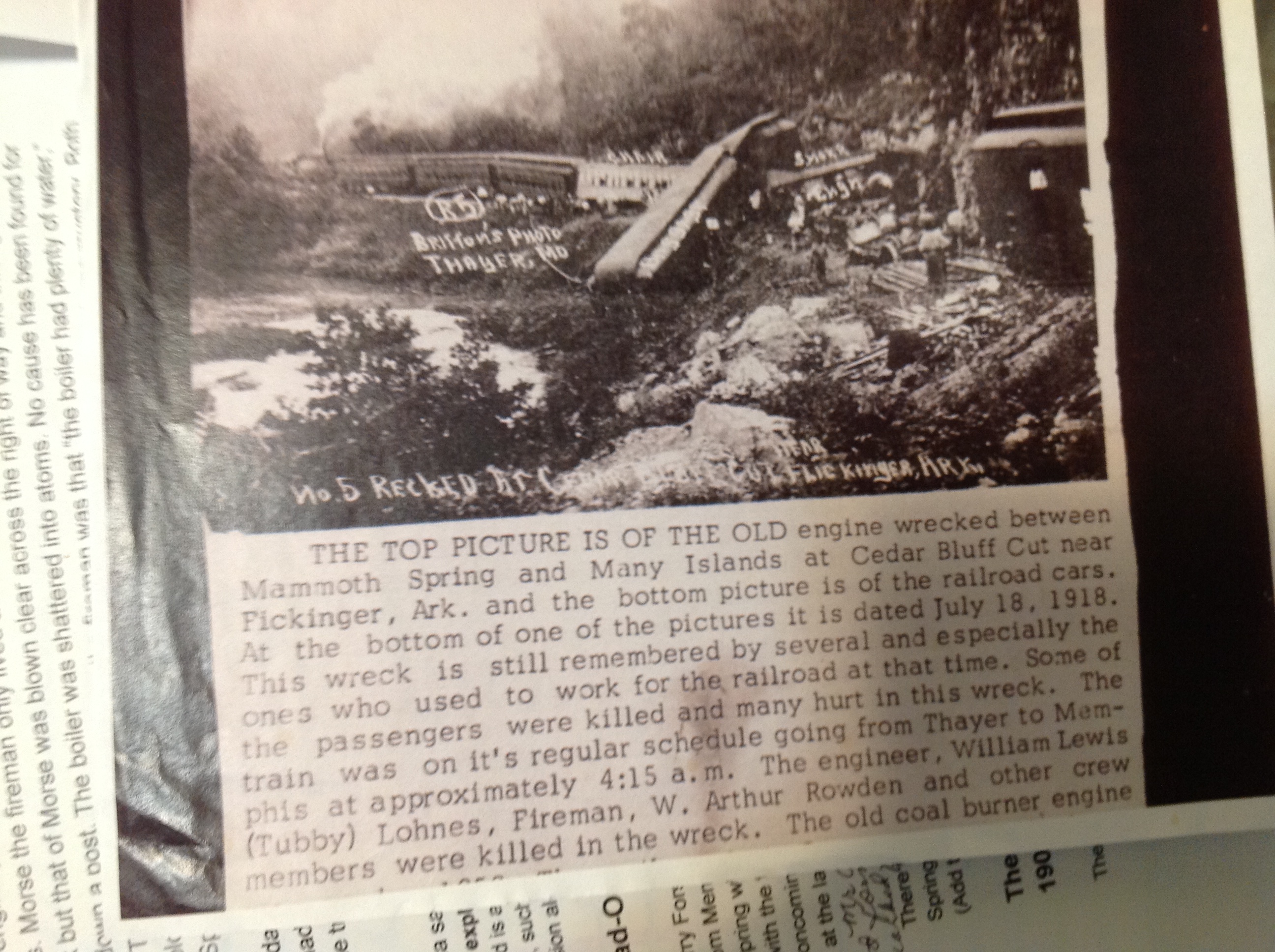
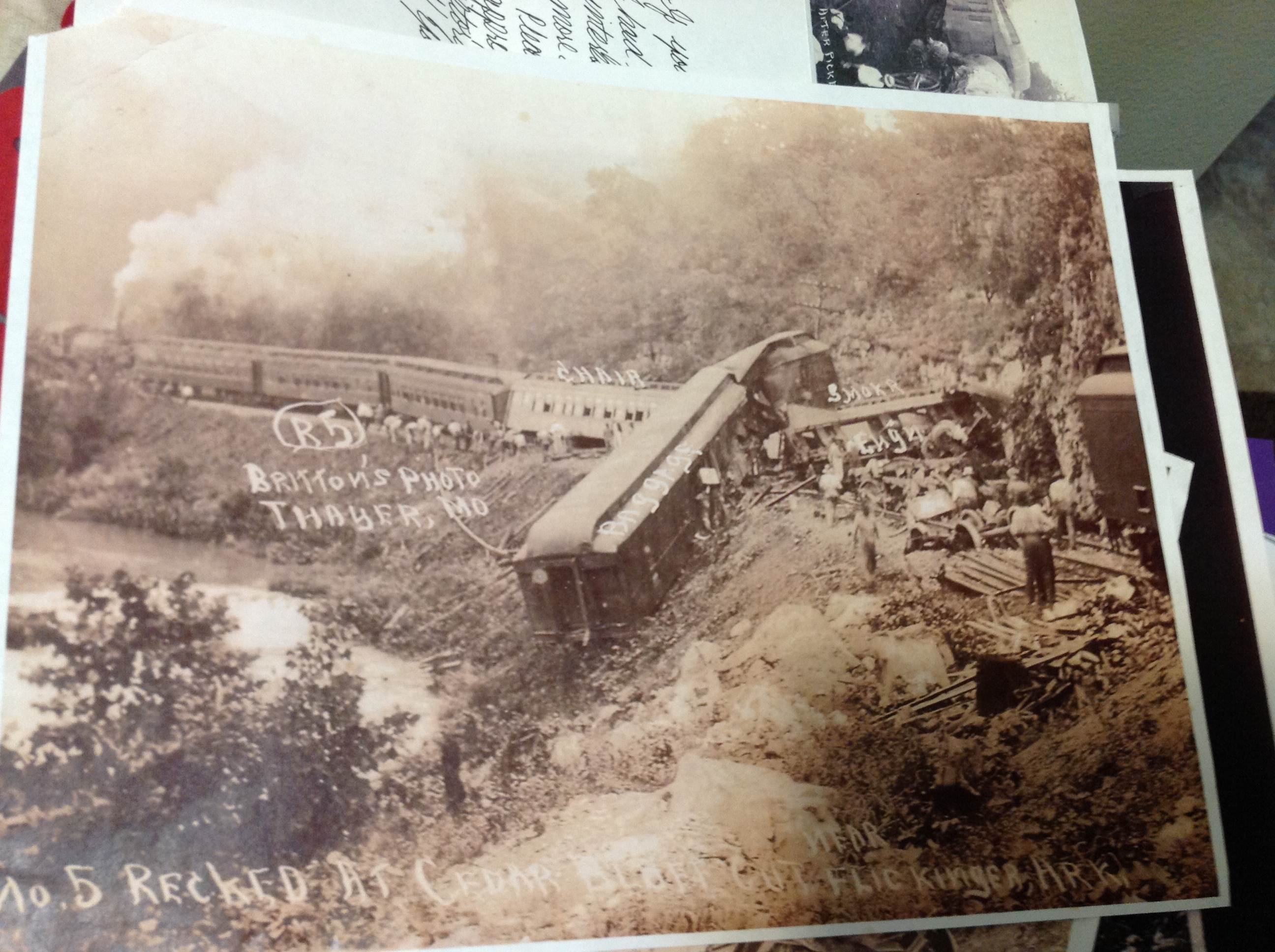
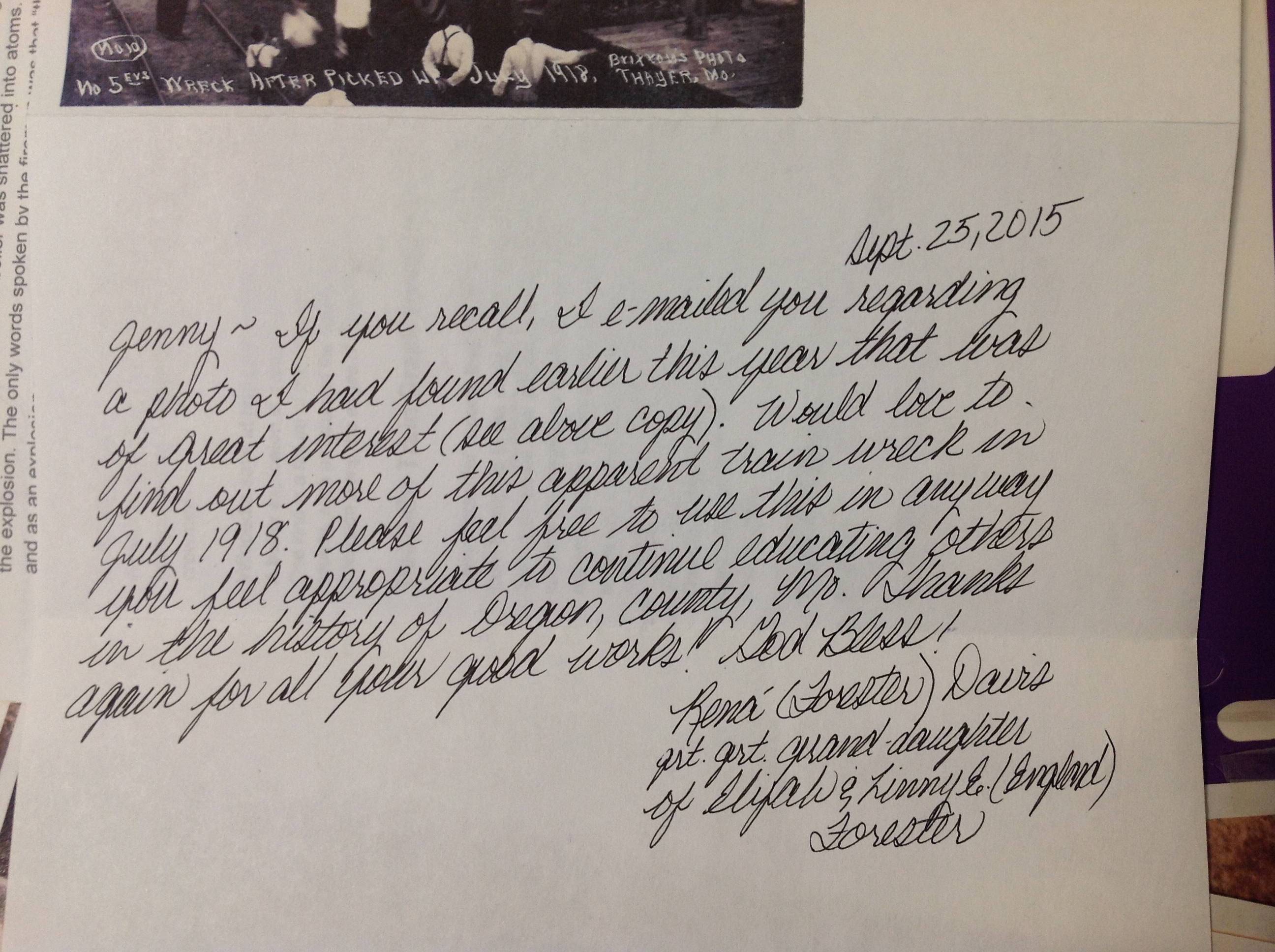
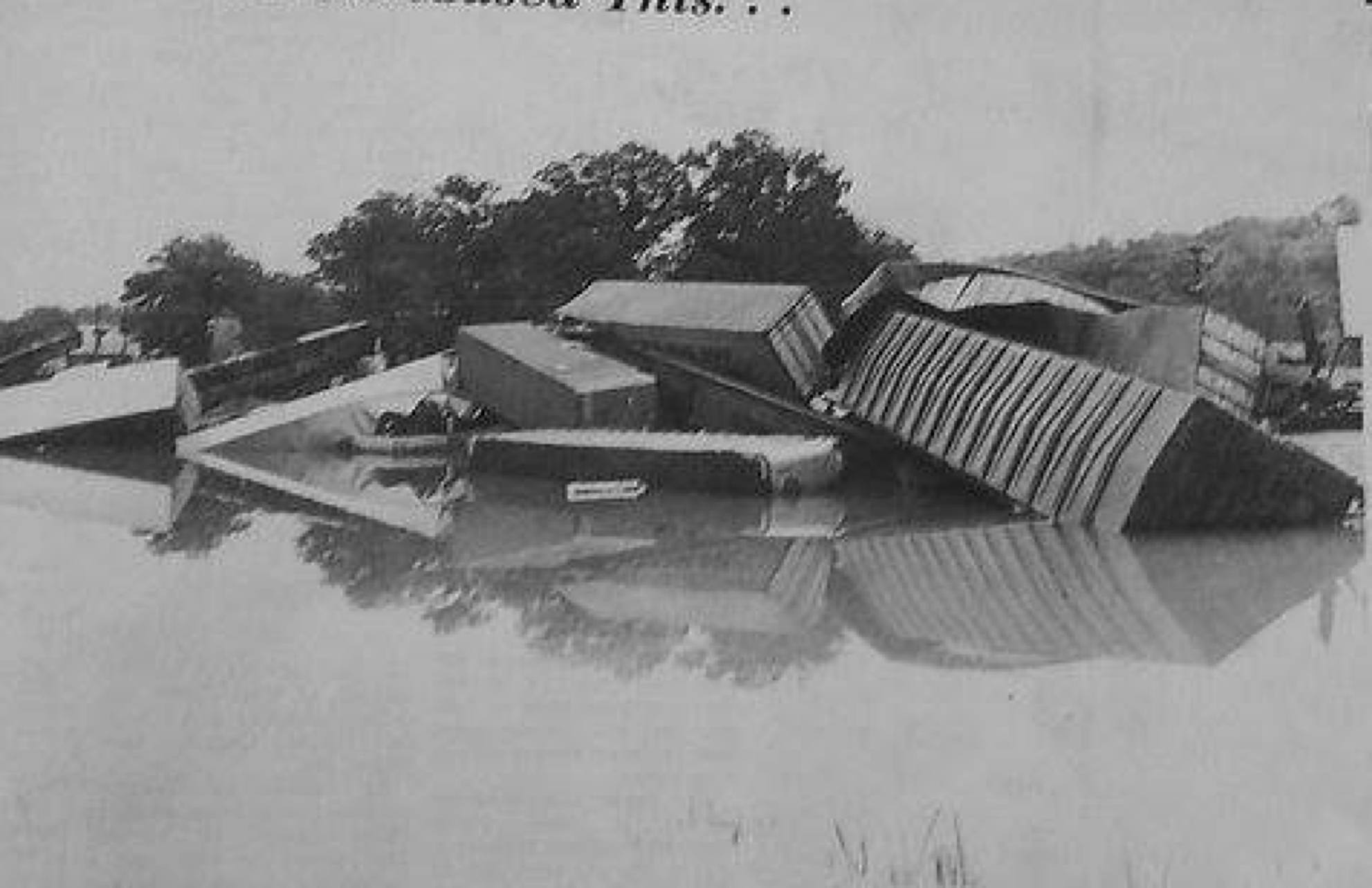
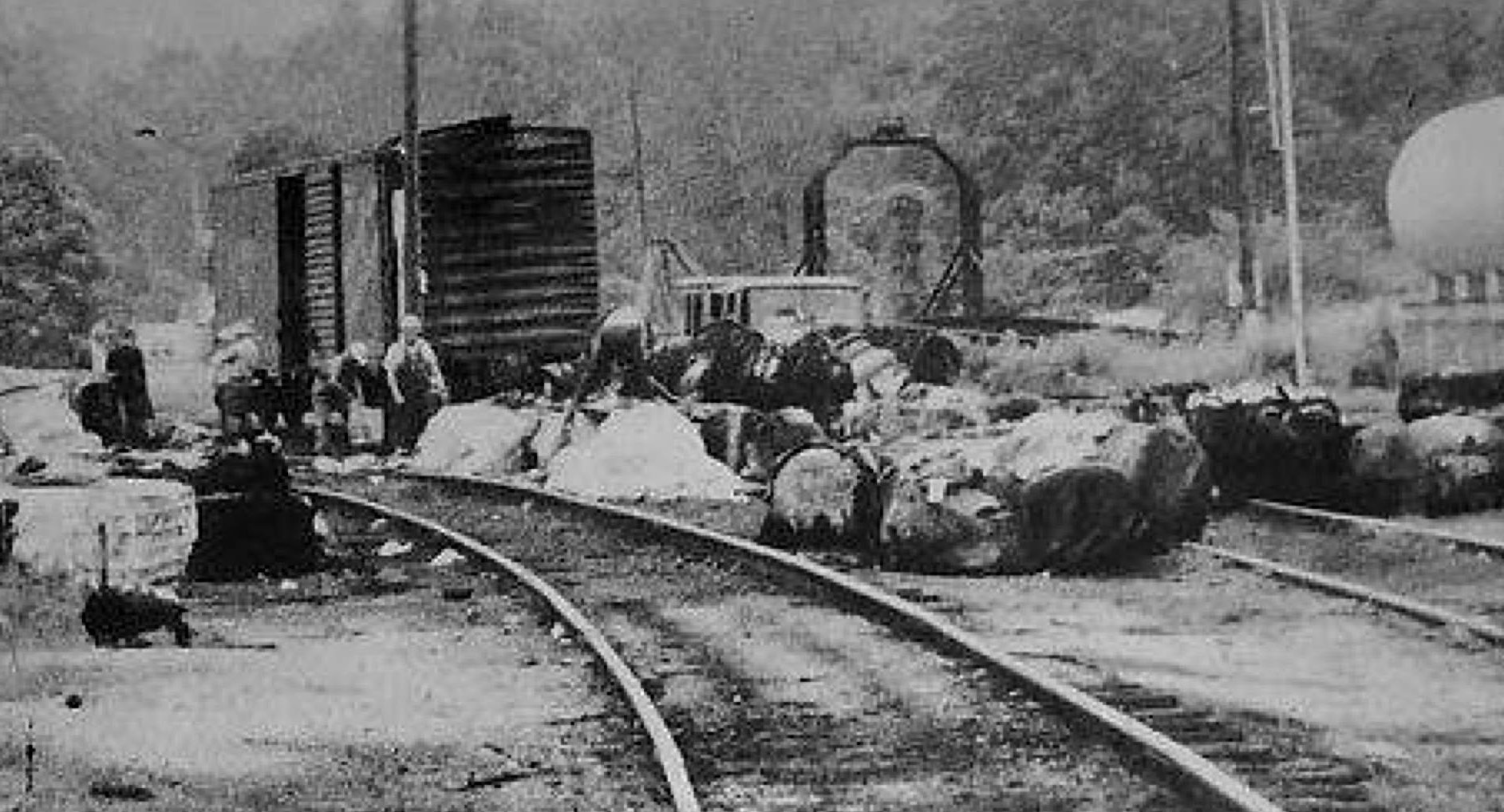
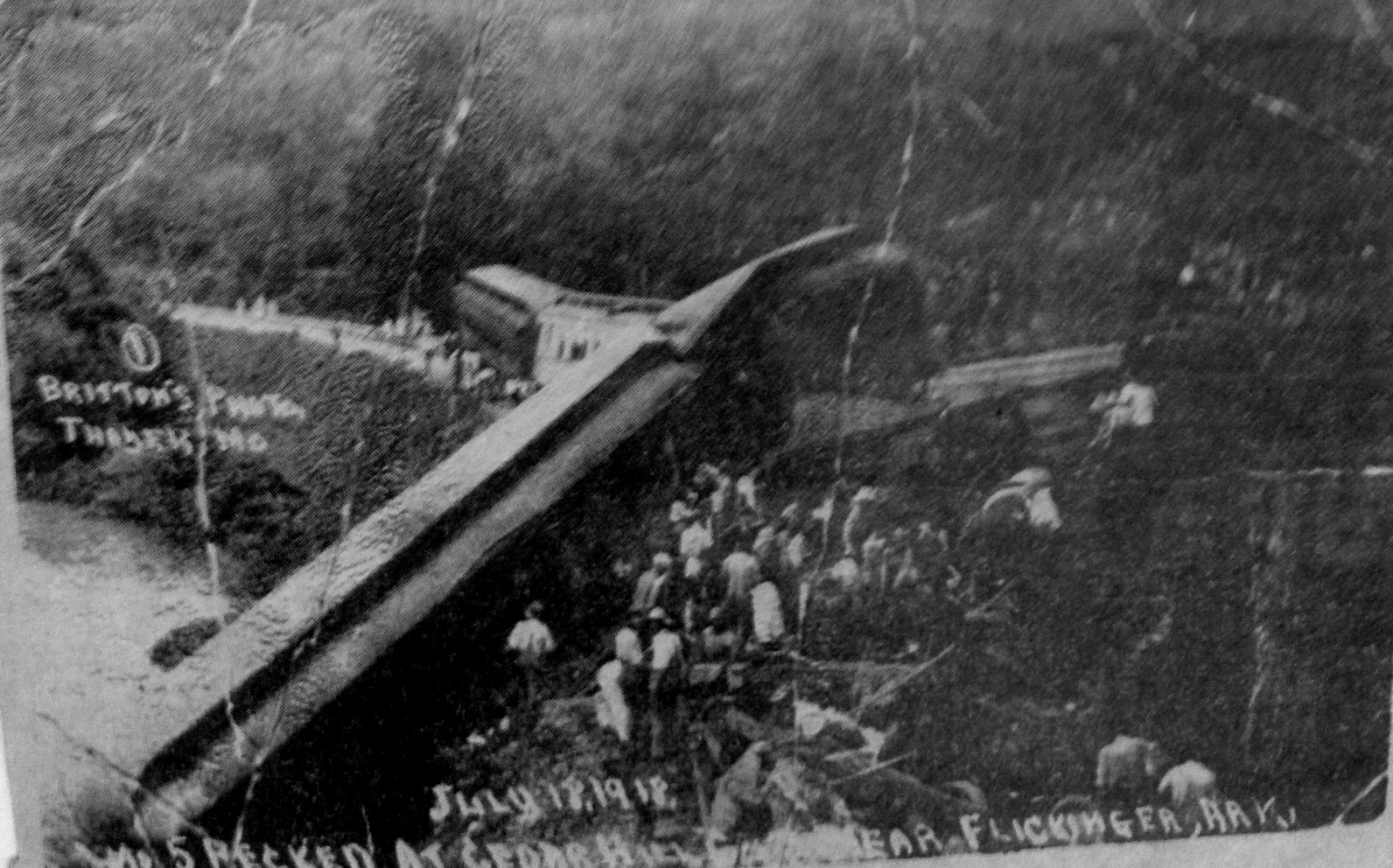
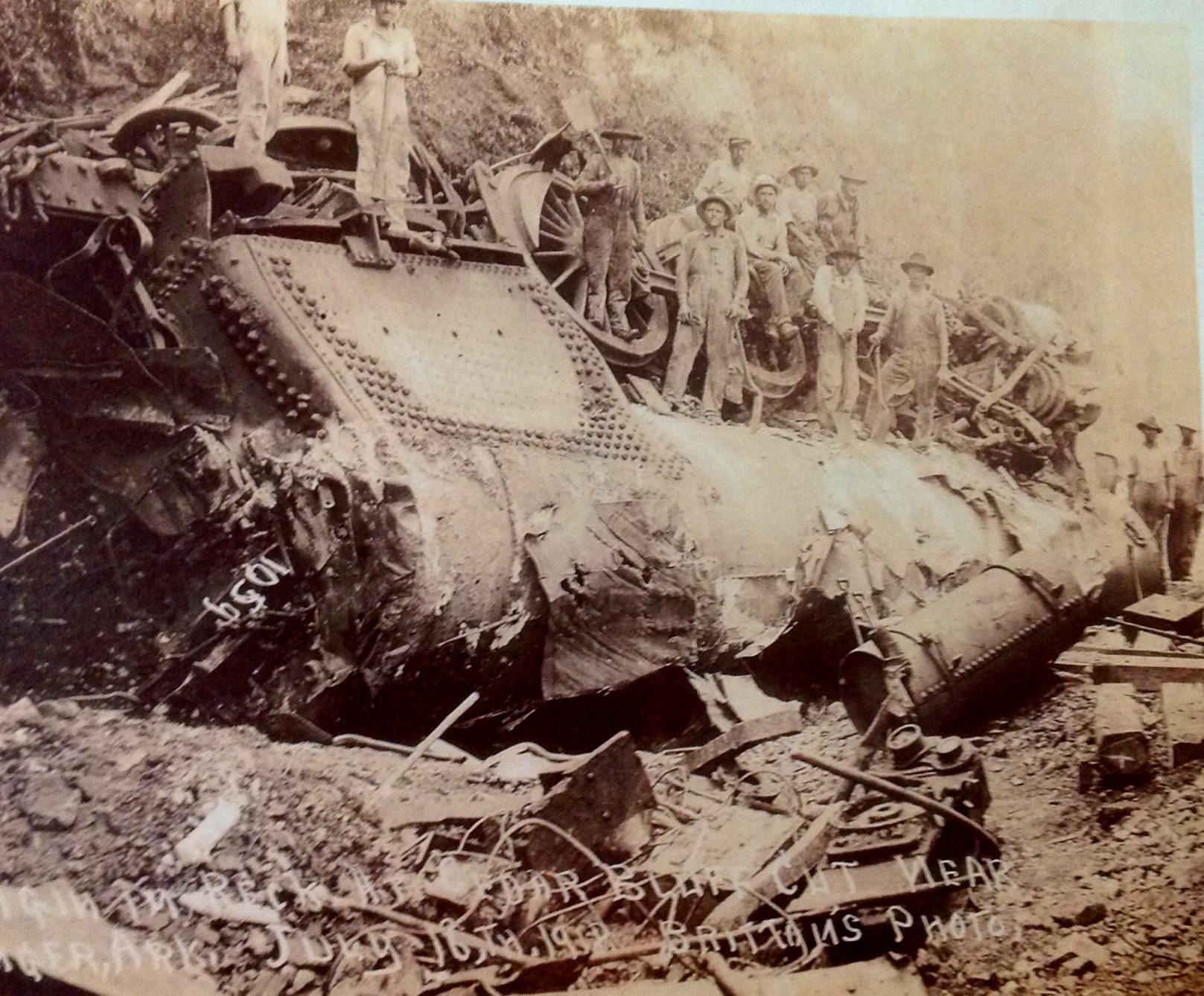
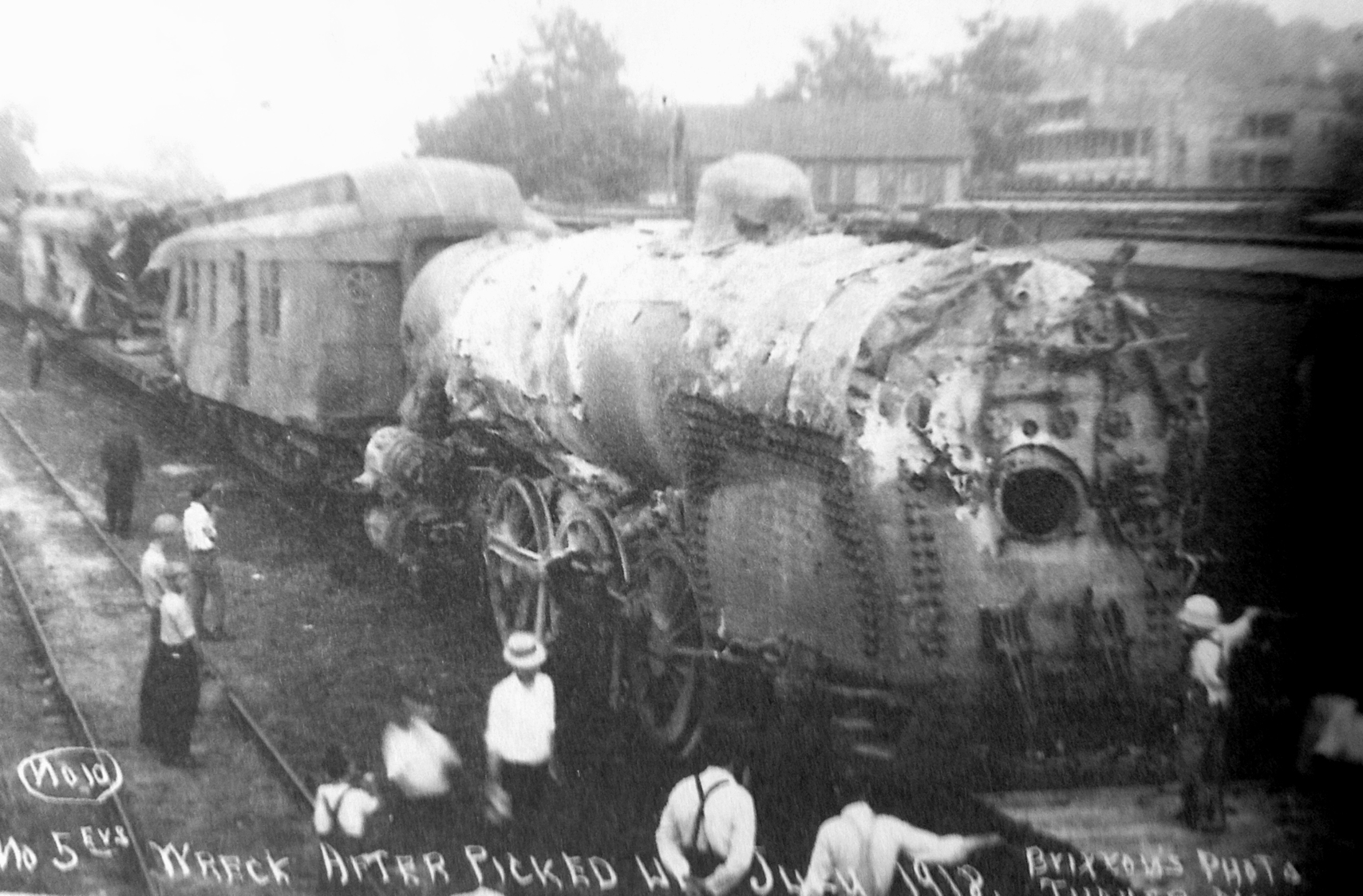
1918 train wreck — additional photographs and source material
These are scans and photographs supplied for the 1918 wreck collection. Dates and identifications follow the source filenames and remain subject to verification. Select an image to see it at full size.
1972 Clay Callaway airplane crash — Jerry Crawford farm
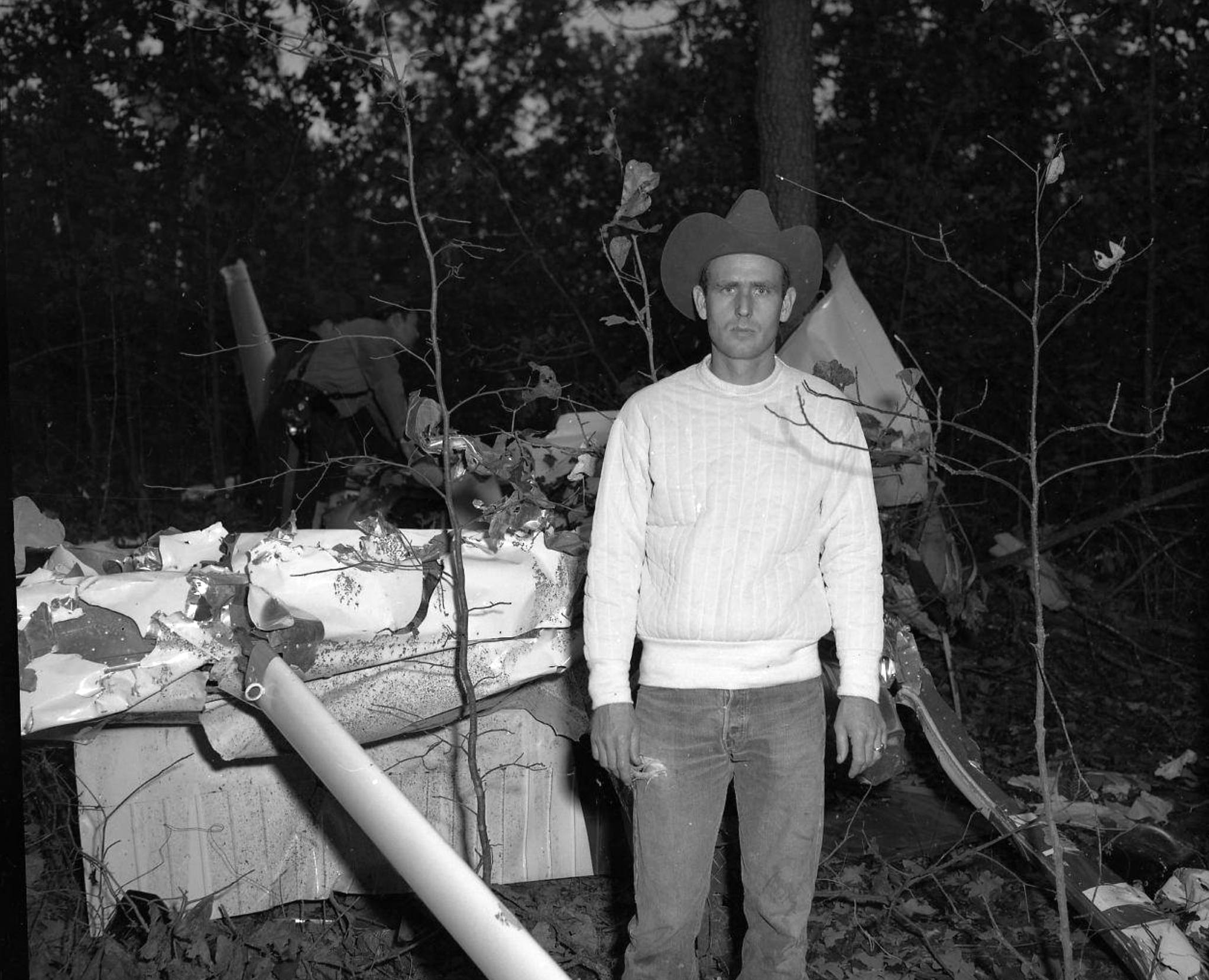
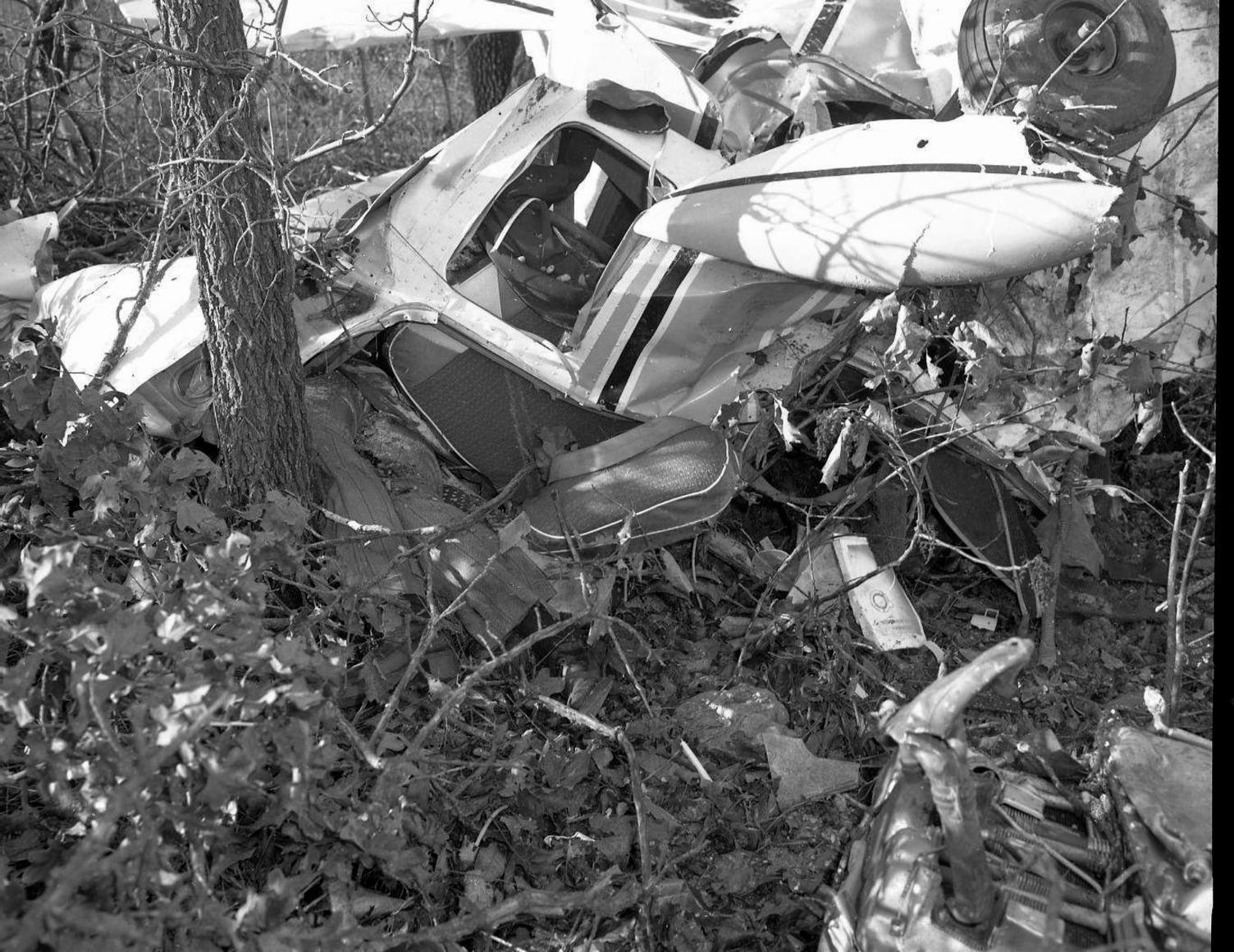
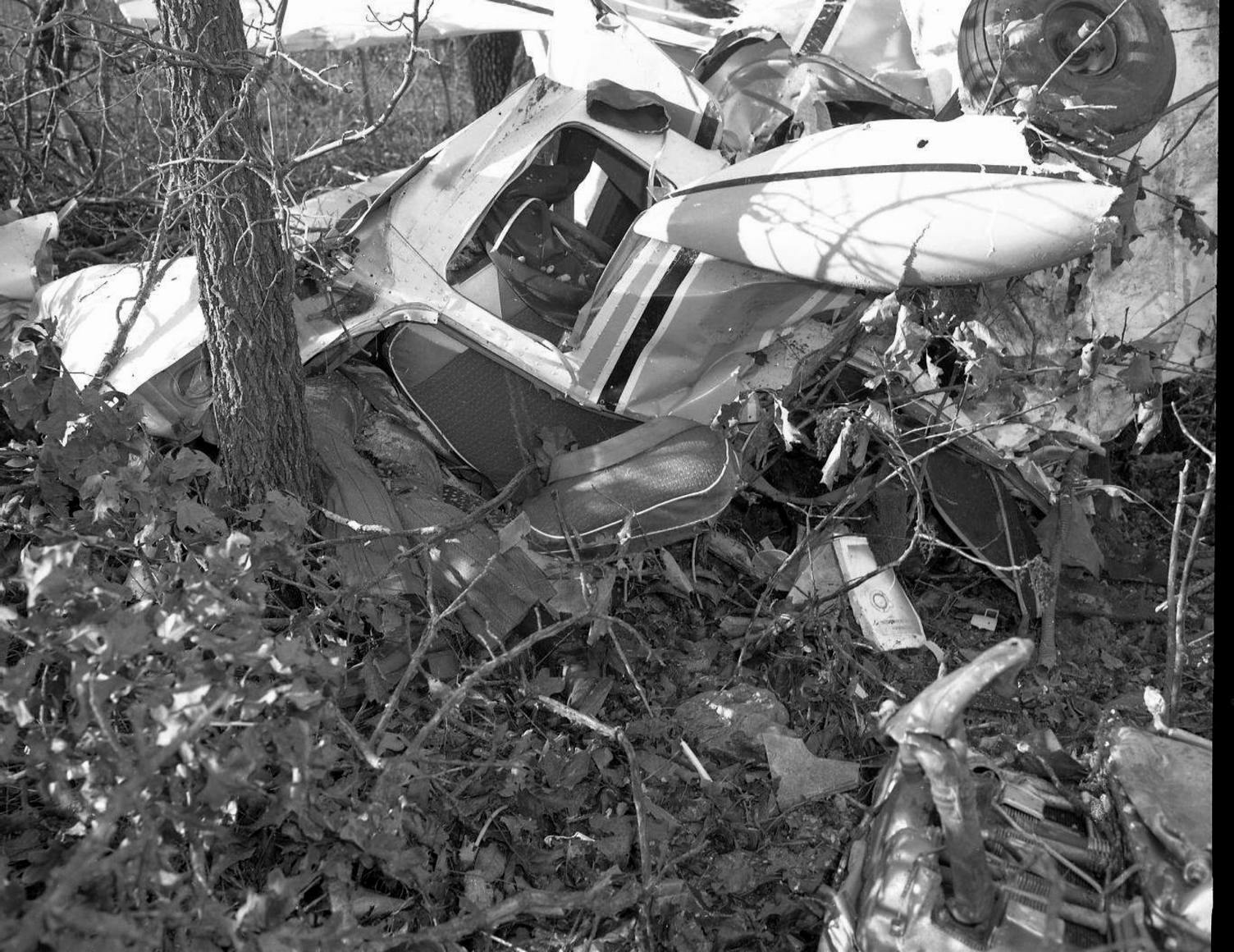
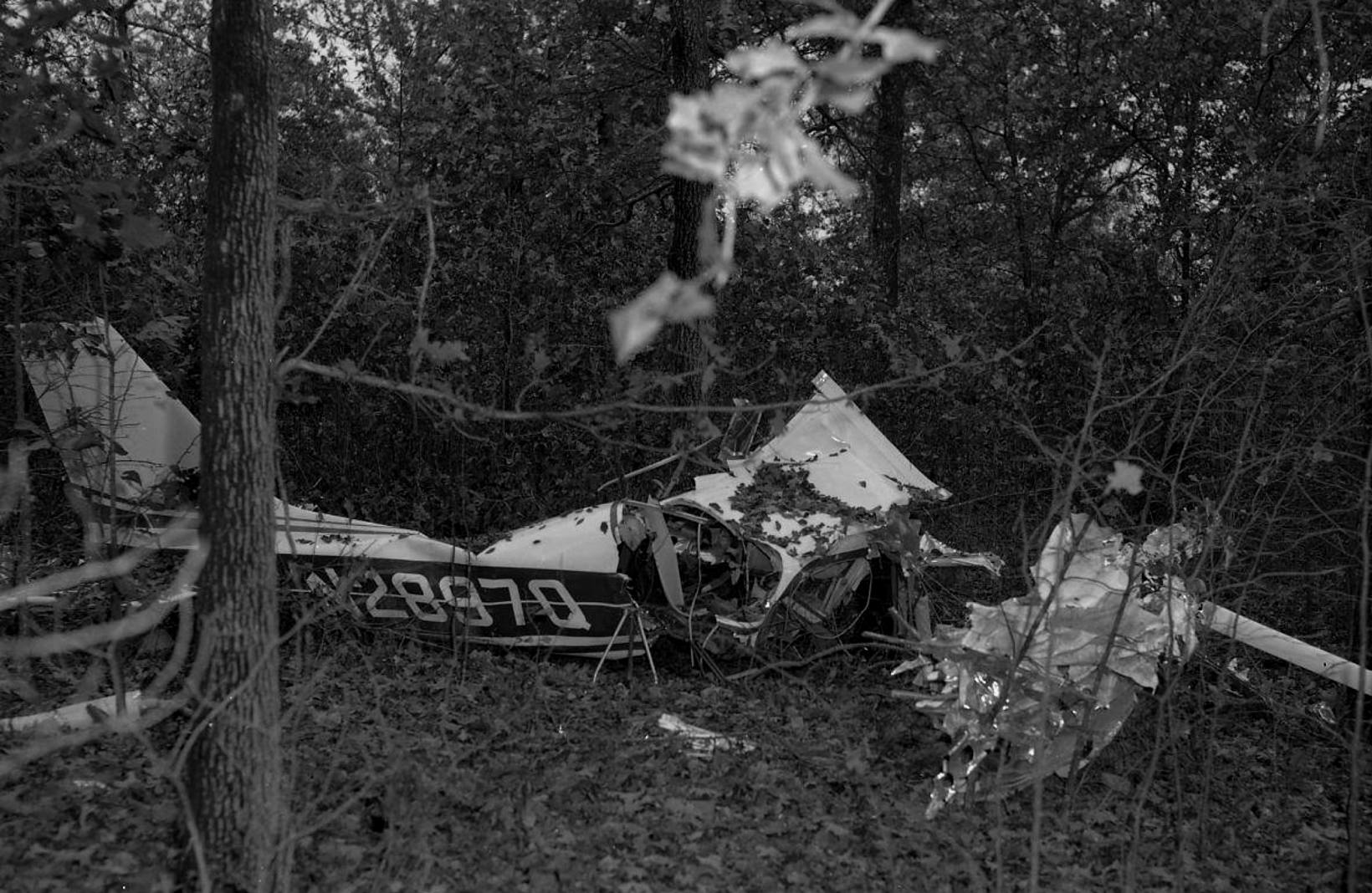
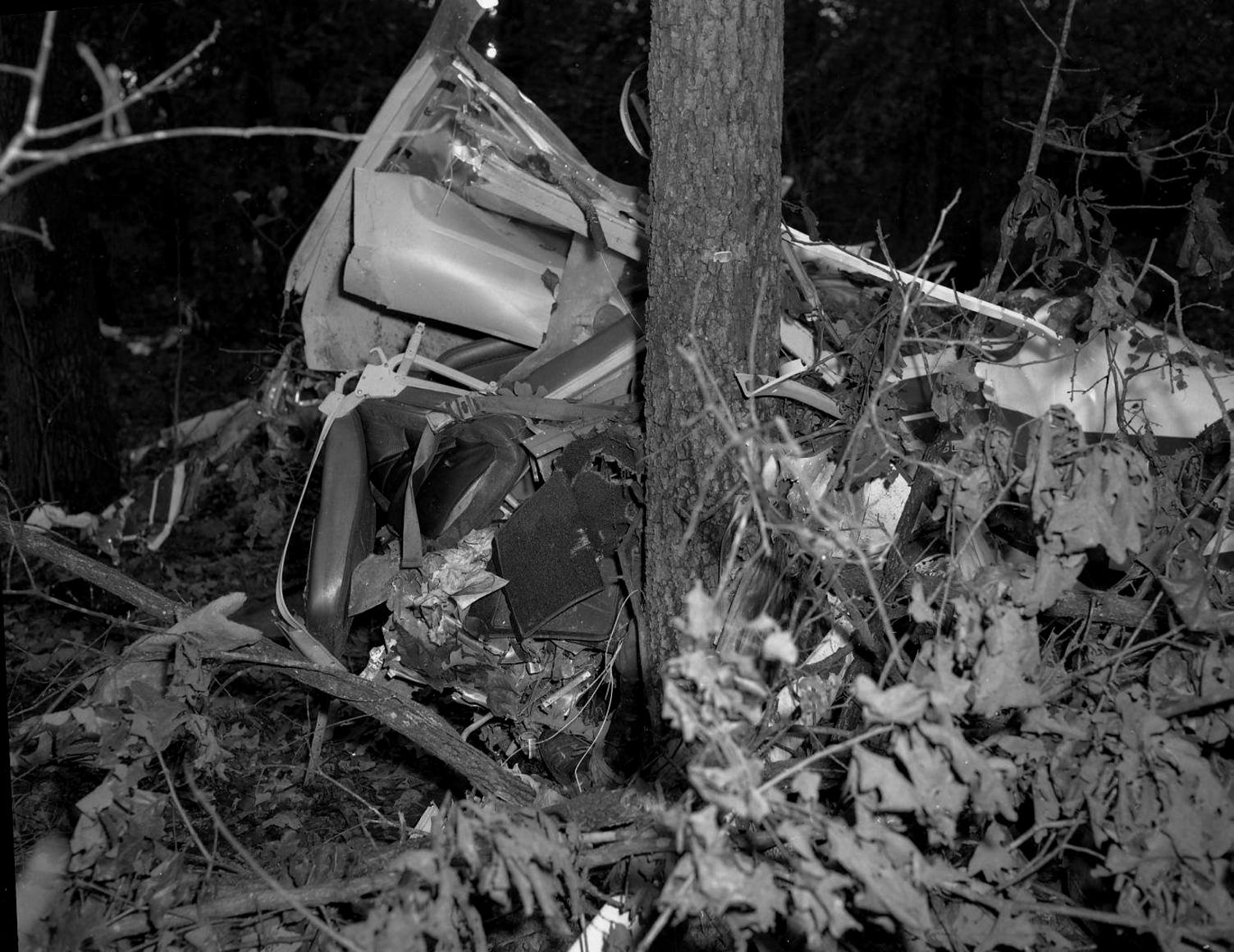
Jerry Crawford beside the Cessna wreckage discovered November 2, 1972, east of Thayer. Original filename: 1972 09 02 Crawford crash 5 with Jerry Crawford d1.jpg (filename date incorrect; preserved for provenance). Identification supplied by collection owner.
Callaway's flight departed Conway, Arkansas, September 1, 1972, and wreckage was discovered on Jerry Crawford's farm east of Thayer in November. These are different dates in the same incident, not separate crashes.
Jerry Crawford was a Thayer High School classmate of Jenny Underwood, who learned about the discovery through a newspaper report, not directly from Crawford.
Mammoth Spring — merchandise, salvage, and community
Two separate Frisco derailments occurred near Mammoth Spring on January 5 and June 14, 1973.
The Big Mammoth Spring Train Wreck — Complete salvage story (page 7)
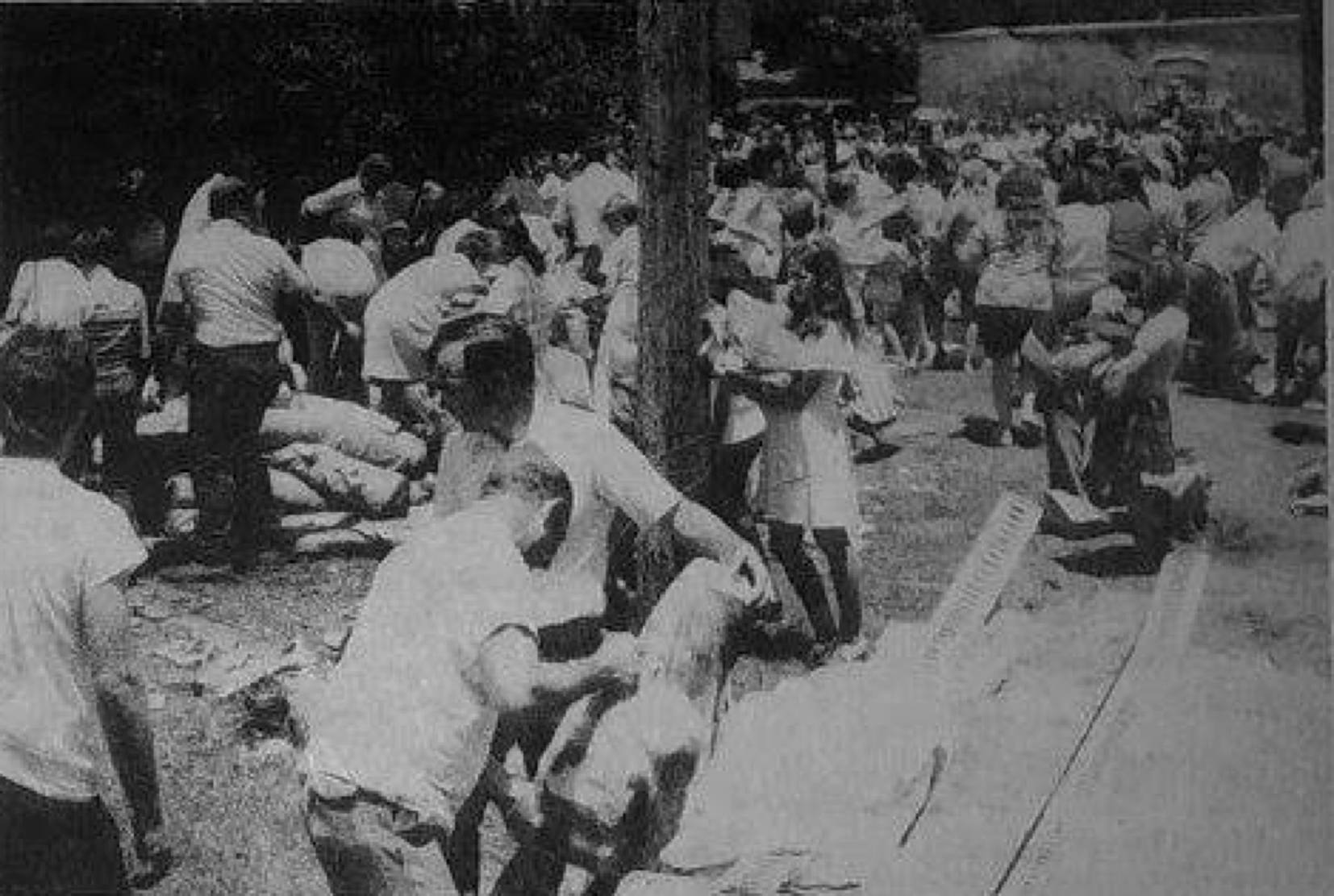
The big Mammoth Spring train wreck brought lots of excitement and activity to the area. There are lots of pictures of the broken up box cars partly in the spring and lots of people there looking at them. I was one of them. We were on our way to summer college classes at Arkansas State College when we noticed the wreck and all the people standing around. We stopped to see what was going on and never did get to school that day.
“Stuff” that had been spilled out of the box cars into the spring was being fished out and sold at real bargain prices. (I always loved a bargain.) I spotted a whole roll of beautiful gold upholstery fabric floating in the spring. It would have perfect for our sofa that badly needed a new upholstery job. Price was $25.00 so I bought it from the fellow that pulled it out of the water. It was a real job getting that wet roll into our little red Volkswagon. We unrolled it on the grass in the yard behind our house so it would dry out. Being a hot summer's day, it didn’t take to long.
This story doesn’t include the cause of or damages from the Mammoth Springs train wreck. This book includes where you may read those details and newspaper articles elsewhere. My story looks at it from a local residents point of view.
Then we went back to see what else was being tossed out of the spring. Children’s green cotton bed spreads with lions, tigers and giraffes printed on them were available for 25 cents each. No one was very interested in them so I bought eight. I could visualize new curtains, a chair cover and bed throws for our girls big upstairs room. Later I washed them, no ironing, and sewed them up. They turned out beautifully and at a great price I could afford.
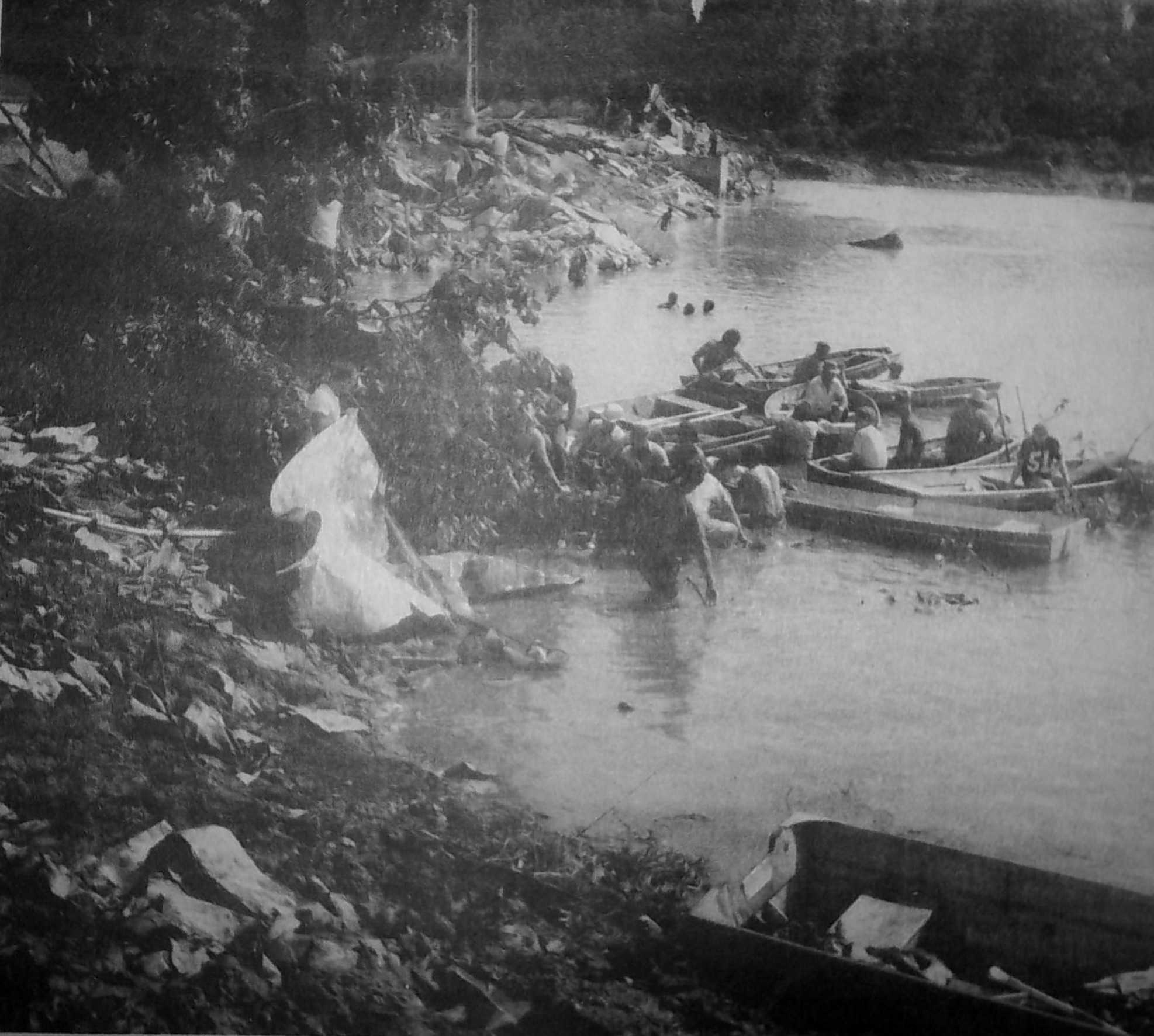
A man gave us a ton of men’s black socks that had been ground into the mud. After two washings to get the mud out of them, I could see they were all alike, no matching!! There were so many pairs, I don’t remember ever needing more socks. Mom and I went down to the wreck the next afternoon. Men diving from boats were pulling up packages of sheets and pillow cases from the bottom of the spring. They pitched them ashore and sold them for 25 cents a package. We bought several. When I cleaned out Mom’s linen closet in 2003, some of the checked ones were still there and in good shape. I believe they were J.C. Penney brand.
There must have been dozens of bolts of one particular cotton fabric. It had a dark blue almost navy background with tiny red and white flowers in it. Almost everyone bought a bolt of this fabric. Before long I saw it everywhere! I think every child in Oregon County had clothes made out of that print, including my girls. No telling how many curtains and quilts were made out of it. Dorothy Barbee made her daughter Niki Barbee (now Whitaker) an old timely dress to wear when she worked at an Ozark Music Theater down in Arkansas. She remembers it well and in fact she still has it!
All in all the wreck was fun and profitable for everyone except the Frisco Railroad and the insurance companies. We kept waiting for the next wreck and it did happen!
In 1947, two small airplanes were based near Thayer, Missouri. Their owners, Scott and Elmer Shepard, had established a small landing strip behind Shepard’s house and garage near the junction of Highways 63 and 19. On July 17, the airplanes collided in midair, killing Elmer Shepard.
Marge Caldwell Shipp was eight years old. She remembered hearing her mother, Nora Caldwell, talking with her cousin Louise “Cupie” Thomason, later Scott, about the airplanes. Marge wanted a ride, and the family arranged to visit the little airfield. Her father was home from his railroad work, and her parents found someone to watch her two younger sisters. But the babysitter was late, delaying the trip.
When the family arrived, both airplanes had already taken off. Grace Shepard told them that Elmer would likely take Marge flying when he returned. The family waited with other spectators. The airplanes came into view above the radio station and appeared to be circling toward the runway. As they drew close together, the onlookers saw them collide and fall from sight.
The spectators drove up Highway 63 toward the crash sites. Marge’s family saw the Scott airplane lodged high in a large oak tree. They were told that Scott and Cupie had survived and were still seated in the aircraft, but that reaching them would require a very tall ladder.
Farther north toward the creek, they found Shepard’s airplane badly shattered among the trees. Marge recalled the silence of the men standing nearby and her parents’ hurried decision to leave. On the way home, nobody spoke. Her parents understood that, had the babysitter arrived on time, Marge might have been aboard Shepard’s airplane.
According to Marge’s account, Grace Shepard later had the wrecked airplane buried at the runway, and the landing strip was plowed up. Despite the experience, Marge remained fascinated by flying. She eventually earned a private pilot’s license and also took part in skydiving.
Remembering Elmer Shepard. The obituary excerpt preserved with the story identifies him as C. Elmer Shepard, son of James E. and Mary Shepard, born February 26, 1909, in Thayer. He died in the airplane collision on July 17, 1947, at age 38.
Source: Marge Caldwell Shipp, “1947 Scott and Shepard Planes Collide,” firsthand account, and “1947 07 17 Elmer Shepard Obit,” reproduced in Train Wrecks and Airplane Crashes, pp. 172–176. This account is presented as a historical recollection; no crash photographs are included.
Train wreck
January 5, 1973
Mammoth Spring: Freight Train Into the Spring
Historical image from source book, PDF page 90. Attribution and reproduction rights to confirm before public posting.
The first of two major 1973 derailments occurred near the headwaters of Spring River, above Dam 1. A Frisco freight train left the rails and a number of cars went into the spring basin. The book describes a wintry evening with freezing rain, wet ground, and difficult cleanup conditions.
The crew included engineer Noel Beard of Mammoth Spring and conductor Carl Griffith of Thayer. The account reports no injuries. Roughly 500 feet of track were damaged; a broken rail was suspected, although the book does not establish a final official cause.
Empty fuel and fertilizer cars were among the equipment in or near the water. There were concerns about contamination and fish, but the contemporary report reproduced in the book described limited observed damage. Crews and specialized wrecking equipment came from outside the area to clear cars and rebuild track.
This accident belongs alongside the June 14 derailment as a two-part story of the railroad, Mammoth Spring, Dam 1 and the river.
Book reference: PDF pages 89–94 (book-printed page numbers may differ). Full book not available for download here.
Historical photograph pending — original image file not yet available.
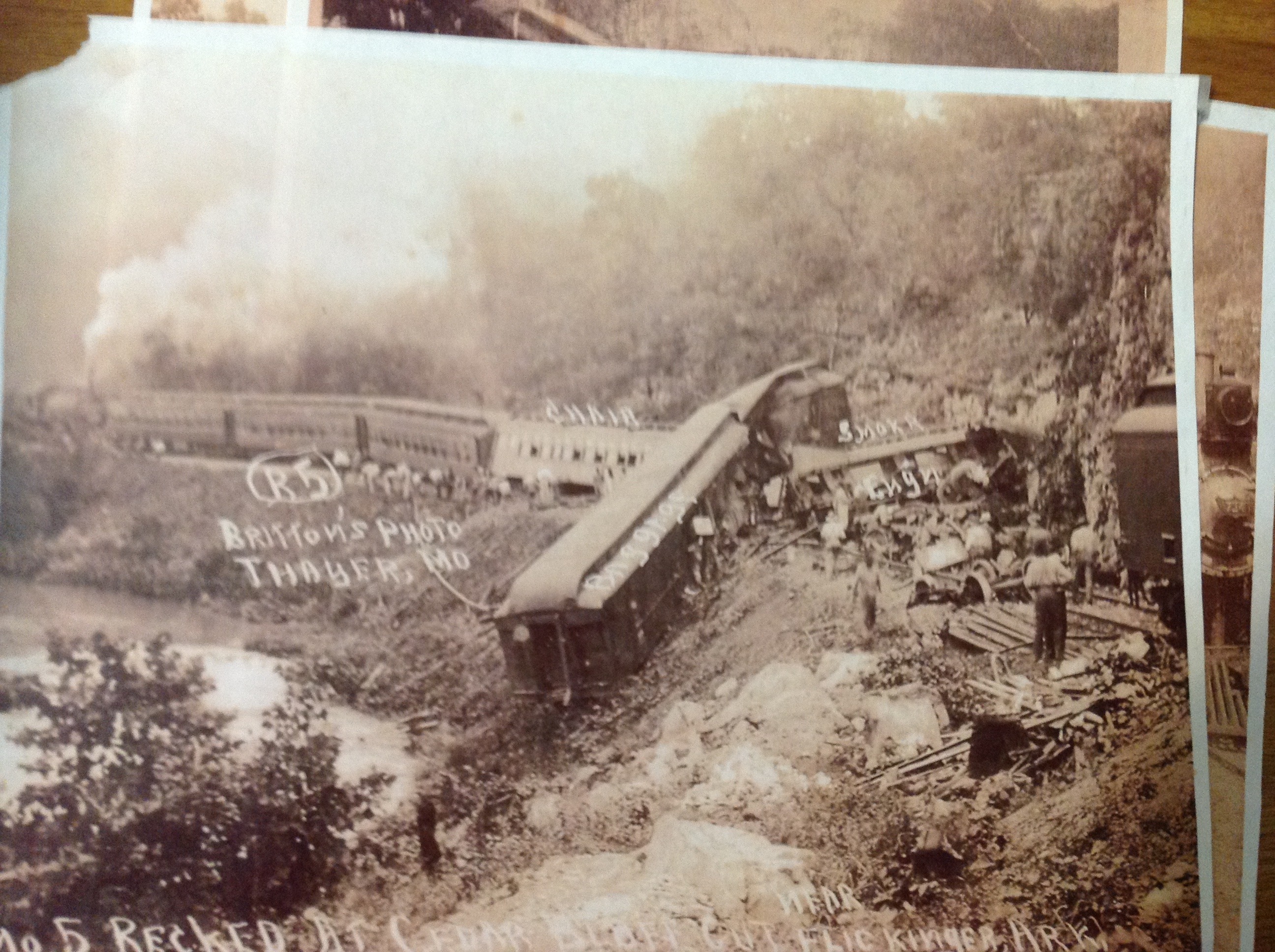
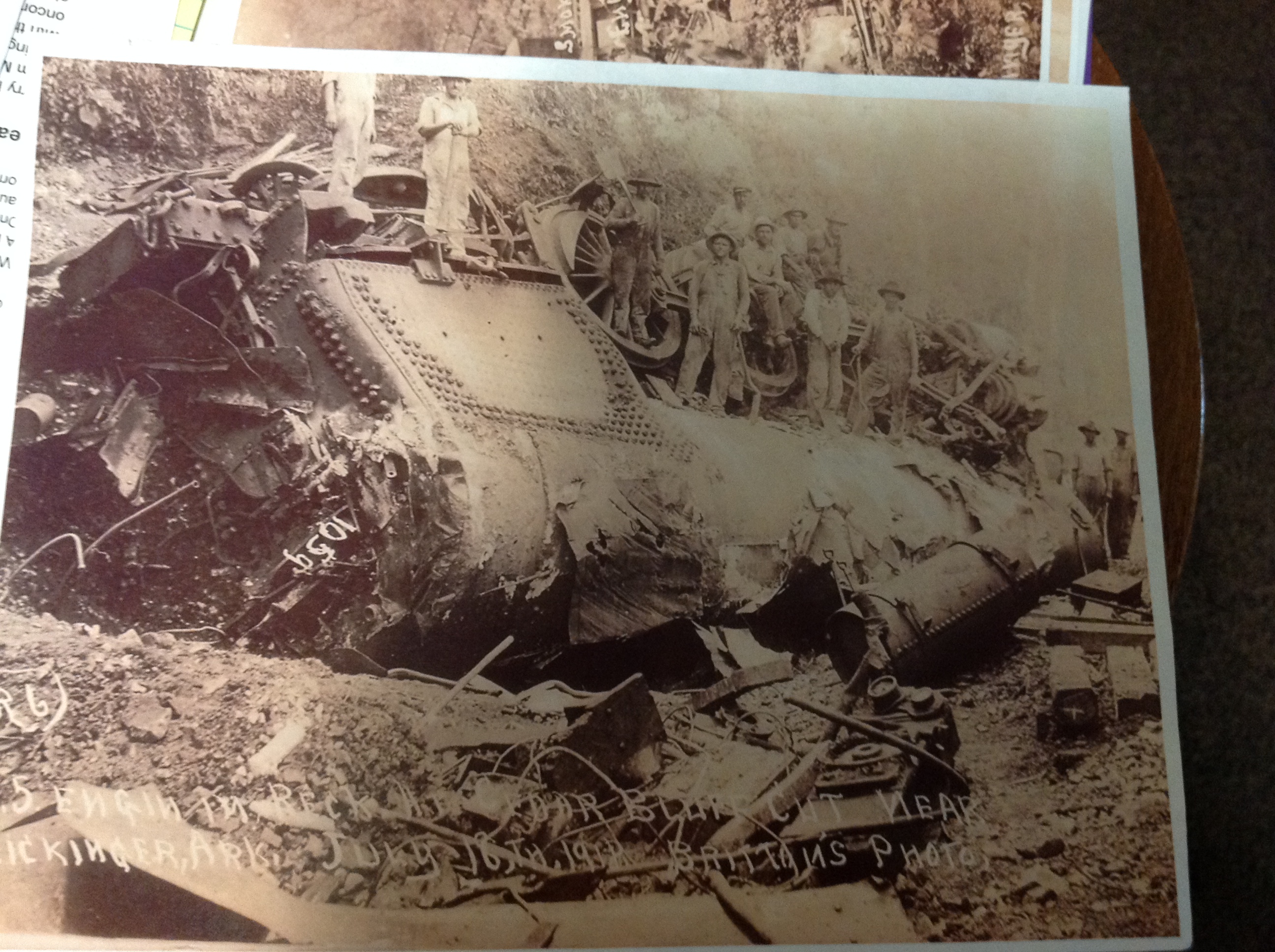
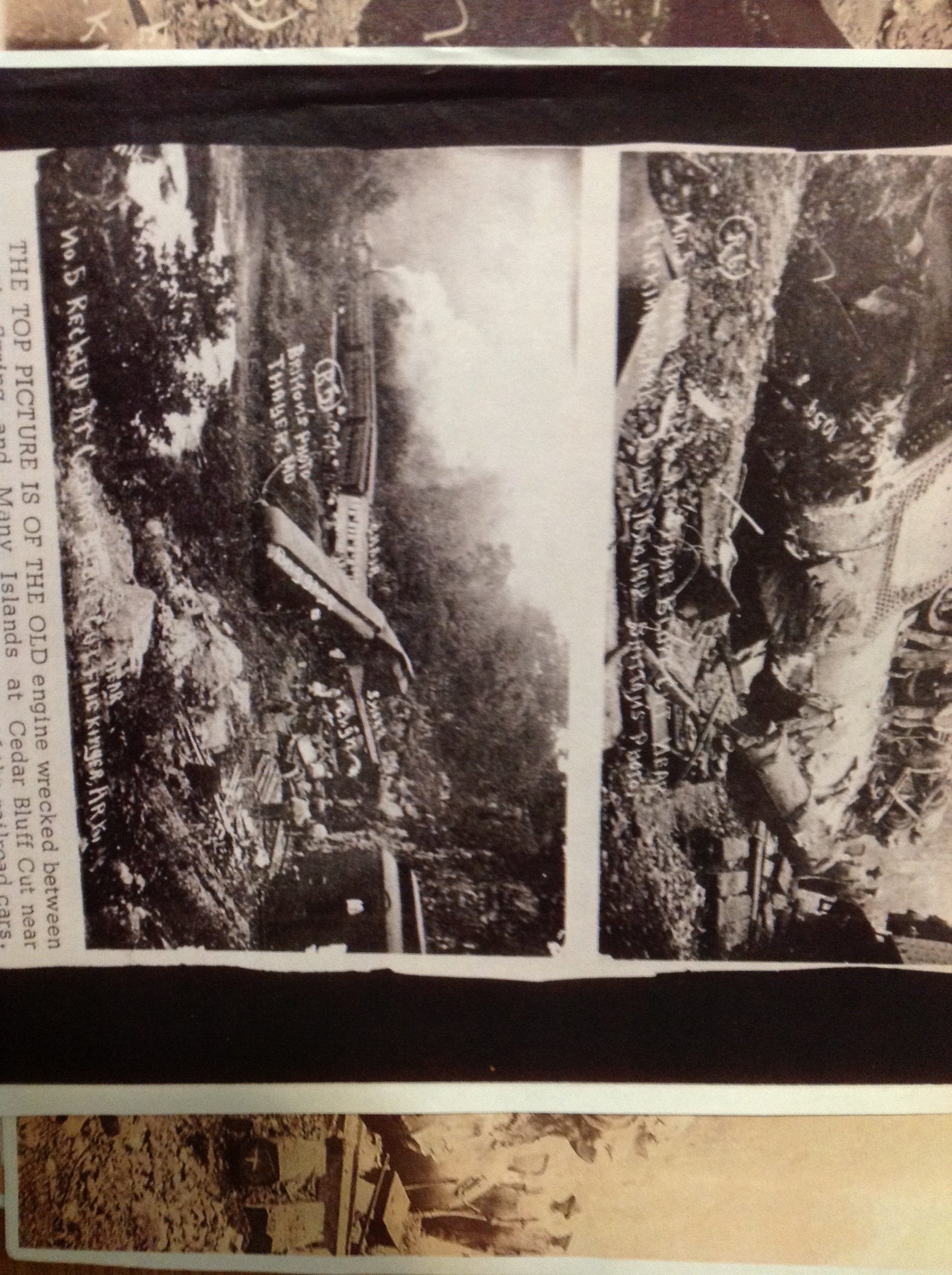
Historical image from source book, PDF page 100. Attribution and reproduction rights to confirm before public posting.
Only months after the January wreck, another Frisco train derailed at almost the same place early on June 14. The book reports that 22 cars left the track and that two of four locomotives, along with freight cars, entered the spring basin near the hydroelectric dam. No personal injuries were reported.
The train carried valuable merchandise toward California: fabrics, clothing, bedding, cigarettes, household goods and other cargo. The book identifies engineer Paul Alford, fireman Gary “Snook” Jones, conductor Archie Hatman, and brakemen Leon Paulette, Orvis Shepard and Lillis Crews.
The derailment damaged the depot roof, destroyed the old freight house and the National Fish Hatchery pumping station, and interrupted electrical service. Hatchery officials reported disruption to ponds that depended on pumped water and some fish losses. Rail traffic was restored after crews worked to reopen the line.
For local families, the most unforgettable part may have been the floating merchandise. The book includes a firsthand recollection of stopping on the way to college, watching goods brought ashore, and buying wet upholstery fabric to dry at home. Other recollections describe sheets, pillowcases and fabrics recovered from the water. Those memories are an important part of the story, separate from the technical accident investigation.
Railroad officials had not established the cause in the newspaper account reproduced by the book; a broken rail was among the possibilities mentioned.
Book reference: PDF pages 98–105 (book-printed page numbers may differ). Full book not available for download here.
Apples and Liquor — Train Wreck Near the Golf Course
Local recollection supplied as “1973 Koshkong Train Wreck Apples and Liquor.txt.” This is a separate wreck from the June 14, 1973 derailment into Mammoth Spring; exact date needs verification.
Apples and Liquor
Not many months after the big “in the Mammoth Spring” wreck, there was another Frisco train wreck north of town near the golf course. It wasn’t easy to get to but a short walk from Highway 63 across Tommy Risner’s land would get you there. Word soon got around about where it was and two high school boys decided to visit the site on their way to school early one morning. Railroad guards hadn’t even gotten their yet. One of the cars was loaded with big Washing Red Delicious Apples, the kind we saw at Christmastime. The car also had cases of liquor on it. I don’t know what kind but I do know AFT officials and Frisco guards showed up later that morning. They quickly discovered one case of liquor had been opened and two bottles were missing. It wasn’t long until someone remembered seeing a car parked on Highway 63.
Then someone else remembered two young boys walking across the field. AFT officers soon added two and two and visited Thayer High School. It didn’t take long to identify the car and determine who it belonged to, and to find out two boys they had been a little late getting to school that morning.
The boys soon admitted they had taken the two bottles but hadn’t opened them. They had hid them in a bulldozer brush pile on the Risner farm. They were found unopened just where the boys said. As far as I know, there were no charges. Two boys just got off very lucky.
Teachers knew some of what was going on, but not the details until much later. We were told not to ask questions and not to talk about anything we knew. I didn’t know the boys very well, they were in Senior High. I can’t remember their names now but I do know they probably learned a big lesson.
Everyone was disappointed that all there was on that wreck was liquor and the Washington Red Delicious Apples. I believe the Washam Brothers ended up with the apples. My mother bought some and our whole family enjoyed them.
Train wreck
About 1930
Cold Spring: A Brakeman Escapes Into Spring River
Historical photograph pending
Max Evans recounts a derailment near Cold Spring, north of the Trace Creek railroad bridge at Mammoth Spring, around 1930. A locomotive and several cars left the track and entered Spring River.
His uncle Curtis Evans was serving as head brakeman and riding in the engine cab. As the engine overturned, he jumped into the river, swam to the opposite bank and escaped injury.
The book also preserves a local legend that one or two cars were left in the river. That possibility is explicitly presented as a mystery, not a verified fact.
Book reference: PDF pages 43–44 (book-printed page numbers may differ). Full book not available for download here.
Max Evans remembers his father being aboard a train that derailed near Bono, Arkansas, during the late 1930s. He recalls injuries but does not remember a fatality, and cautions that the date and details are uncertain.
The book names Darrell Adams as engineer, Roy Ingram as fireman, Dick Trussell as conductor, and Bo Adams, G. C. Evans and O. L. Turrell as brakemen.
A photograph shows Frisco engine 706 on its side. The book notes that the locomotive was repaired and later photographed still in service in Enid, Oklahoma, in 1948.
Book reference: PDF pages 43–44 (book-printed page numbers may differ). Full book not available for download here.
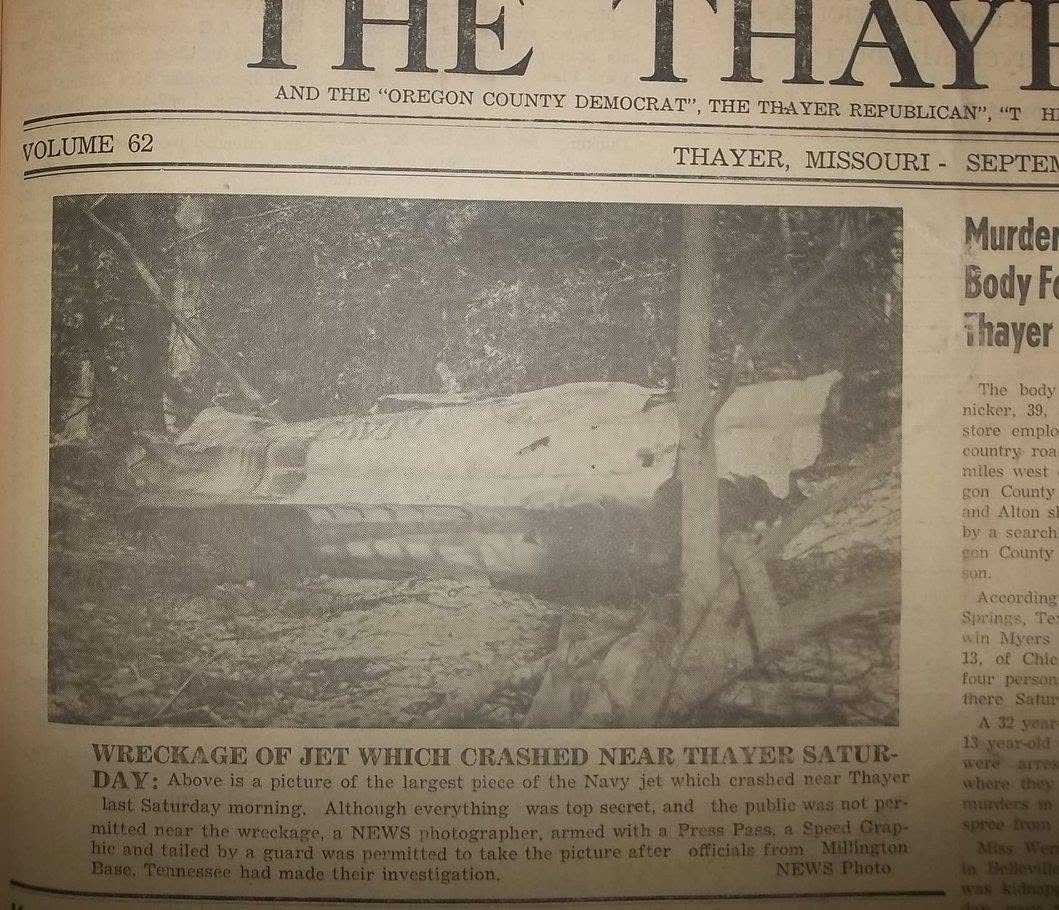
Navy Jet crash photograph; date remains under review · Display file: 1961 09 08 Thayer plane crash Navy Jet.jpg · Additional photographs in the Navy Jet gallery
The book collects an account and a Thayer News report about a Navy jet from the Millington, Tennessee base that crashed on the Rex Moore farm, about seven miles northeast of Thayer. Its heading gives September 8, 1961, while the reproduced article describes the crash as occurring on a Saturday; that dating needs reconciliation before final publication.
The pilot, identified as Lt. William D. Scott, reportedly heard what sounded like an explosion near the rear of the aircraft while passing over Thayer. He steered away from populated areas, ejected, and survived without injury. The aircraft crashed near Warm Fork Creek.
George Mainprize is cited as recalling fire before the ejection. Military personnel guarded the wreckage and transported it to Millington for investigation. This is a military accident, so an NTSB civil-aviation report should not be assumed to exist.
Book reference: PDF pages 190–191 (book-printed page numbers may differ). Full book not available for download here.
Historical image from source book, PDF page 201. Attribution and reproduction rights to confirm before public posting.
The book reproduces reporting on the disappearance of pilot W. Clay Callaway, 54, of Searcy, Arkansas. He departed on September 1, 1972, for Davenport, Iowa, in a single-engine Cessna and did not arrive.
After approximately two months, Jerry Crawford found the wreckage on November 2 while searching for cattle on his father Loren Crawford’s farm, about five miles east of Thayer. The site was wooded, and authorities recovered the pilot’s remains.
The book reports that investigators considered a storm and possible disorientation, but those suggestions should not be presented as an official probable-cause determination without the accident record. The book identifies the aircraft as a 1971 Cessna 172L and gives Callaway’s vocational-school occupation.
Book reference: PDF pages 201–203 (book-printed page numbers may differ). Full book not available for download here.
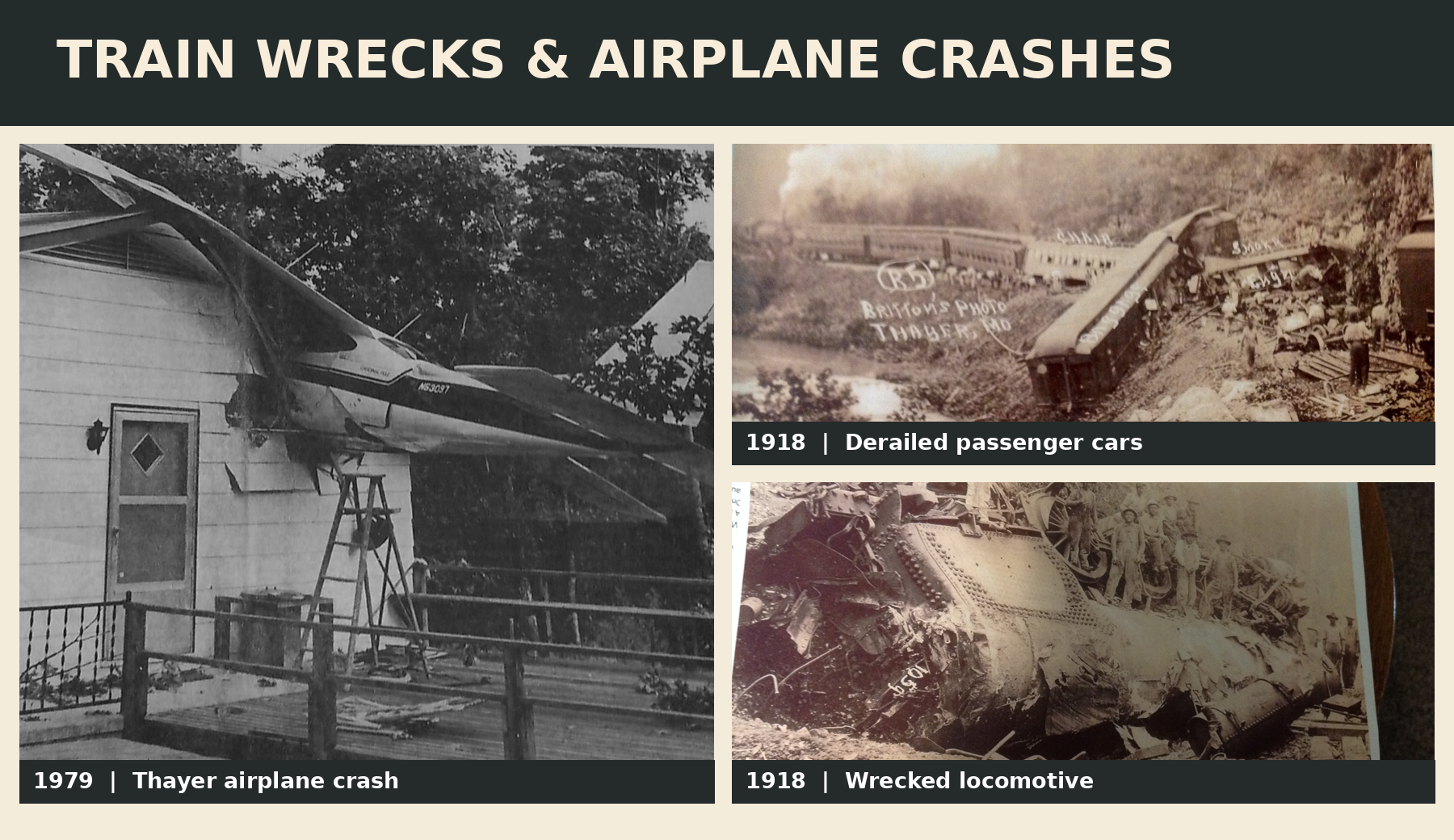
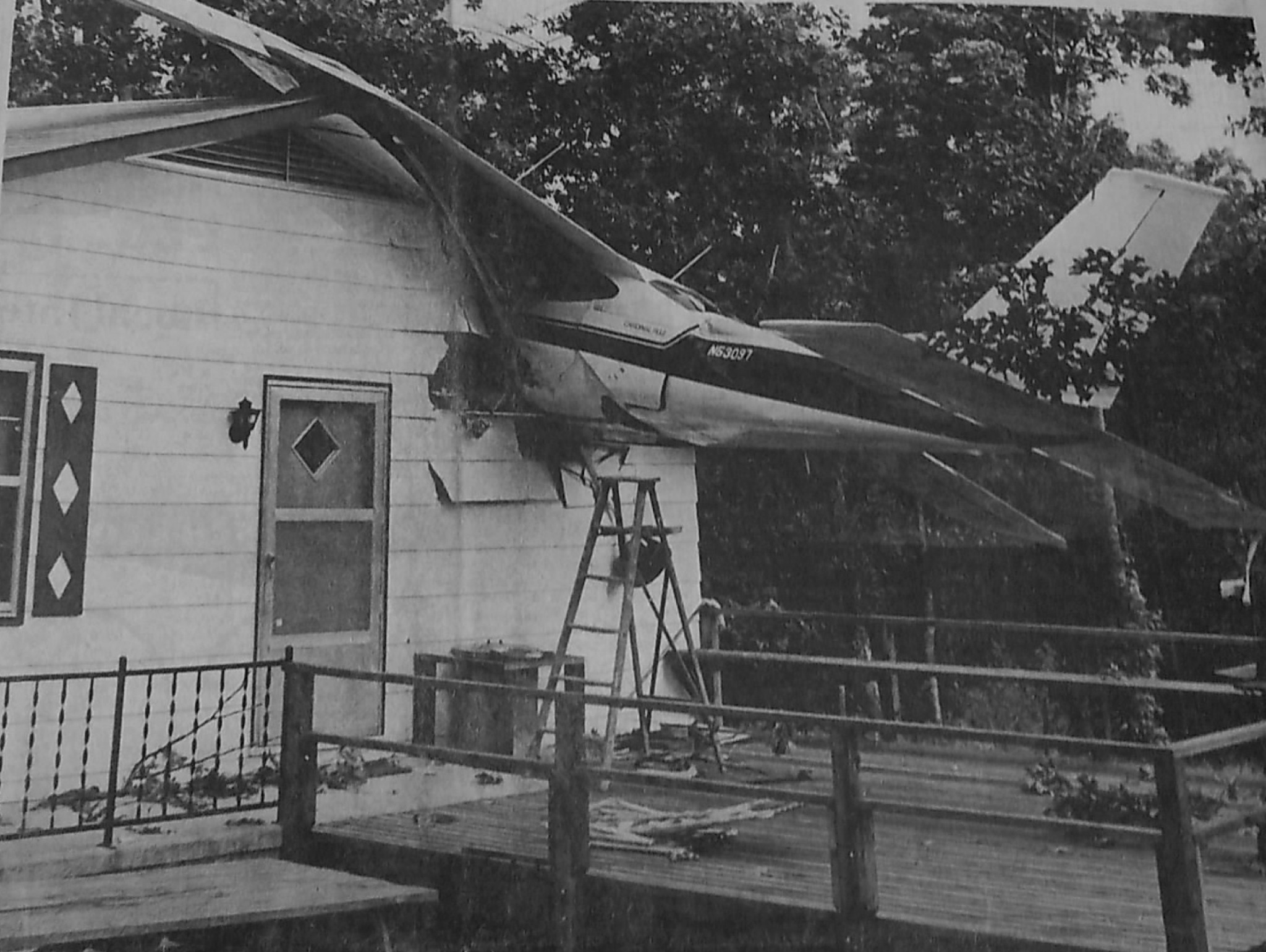
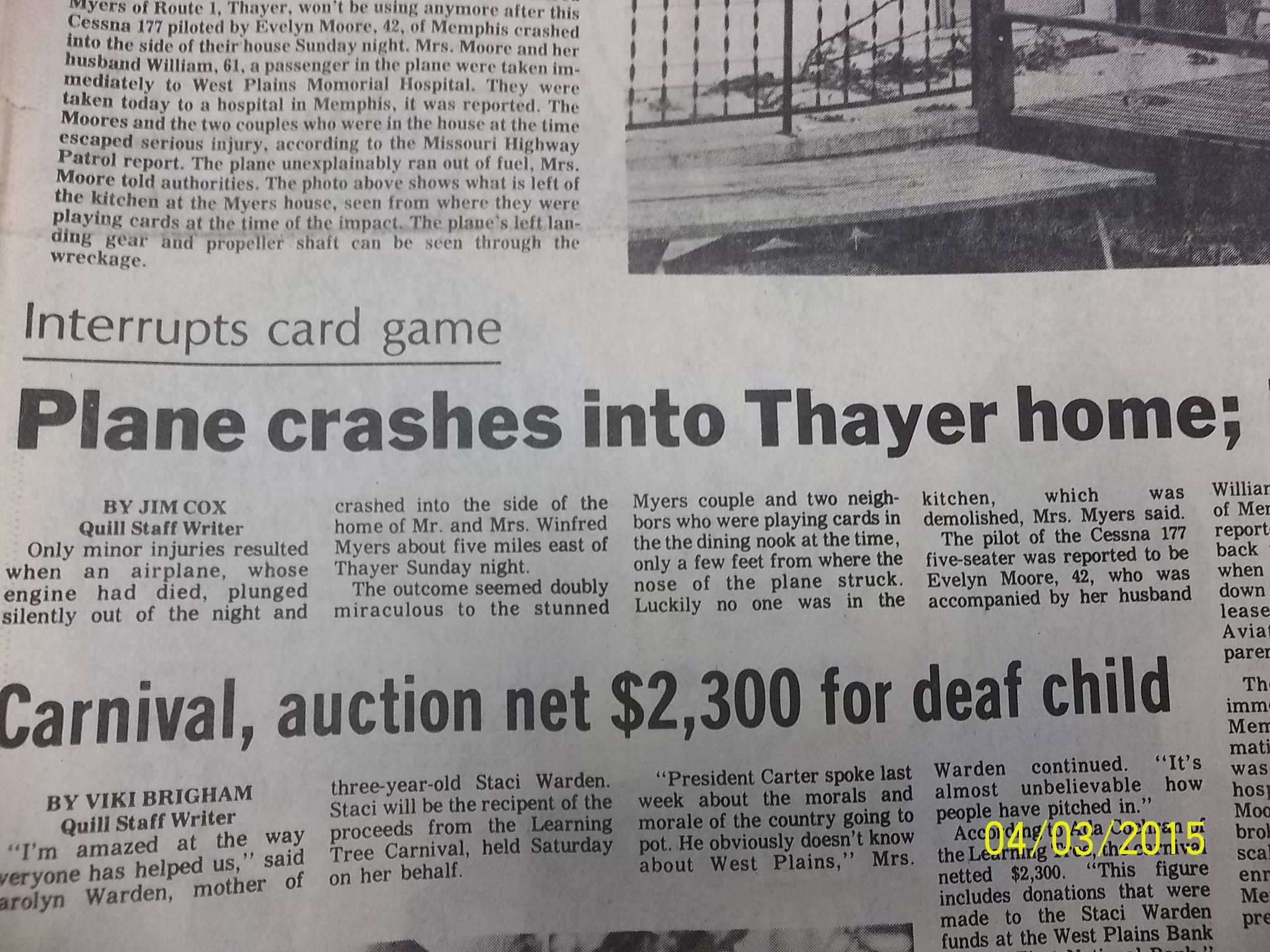
The July 23, 1979 West Plains Daily Quill reports the crash occurred the preceding Sunday night, July 22. The uploaded photograph filename contains a different July date; retain the original filename while distinguishing it from the newspaper event date.
Cessna 177 lodged in the Myers home; published July 23, 1979 · Original filename: 1979 07 09 Thayer Plane crash in home d1.jpg
A West Plains Daily Quill account preserved in the book describes a Cessna 177 striking the home of Winfred and Mrs. Myers in Thayer. Evelyn Moore, 42, of Memphis was flying, with her husband William, 61, aboard.
The Myers family and neighbors were playing cards near the kitchen when the airplane struck. The kitchen was demolished, but the newspaper account reports that the occupants and people in the house escaped serious injury. The Moores were treated at West Plains and later transferred to Memphis.
The pilot reportedly told authorities that the airplane had run out of fuel. That is a reported statement, not a substitute for the official accident findings. The book contains a photograph of the damaged kitchen and airplane wreckage.
Historical photograph pending — original image file not yet available.
West Plains Daily Quill front page, July 23, 1979 · Original filename: plane crash in home pix c.JPGClose-up of July 23, 1979 newspaper account · Original filename: plane crash in home a.JPG
Book reference: PDF pages 209–211 (book-printed page numbers may differ). Full book not available for download here.
The book reproduces a West Plains Daily Quill report by Dennis Crider about a fatal crash approximately one-quarter mile east of Thayer Airport. The men were identified as Danny E. Nichols, 31, a flight instructor from Thayer, and Wayne E. Smothers, 24, of Mountain Home, Arkansas.
Witnesses reported a low-wing Grumman American making low passes and practicing airport maneuvers before it stalled or lost control near a hillside. The account says the engine compartment caught fire after impact and that investigators had not yet determined who was controlling the aircraft.
The FAA and NTSB were expected to investigate. This account describes what was reported immediately afterward; it is not an official final determination.
Book reference: PDF pages 211–214 (book-printed page numbers may differ). Full book not available for download here.
The book reproduces an NTSB accident summary for March 17, 1982, at Thayer Memorial Airport. It identifies Cessna 172N registration N73828 and NTSB case MKC82DA045. The flight was a personal flight under Part 91, departing Thayer for Harrison, Arkansas.
According to the reproduced summary, the pilot’s seat slid fully rearward just as the airplane became airborne. The pilot could no longer reach the rudder pedals or engine controls. The aircraft went out of control and struck trees beside the runway.
The reproduced findings cite an unsecured seat and inadequate preflight checking. The aircraft was destroyed; the pilot was not injured. The official case number provides a precise starting point for retrieving the original NTSB record.
Book reference: PDF pages 214–216 (book-printed page numbers may differ). Full book not available for download here.
Official investigation: NTSB case MKC82DA045 (Cessna N73828).
West Plains Airport: Carl Reeves and Jack Bowers Killed
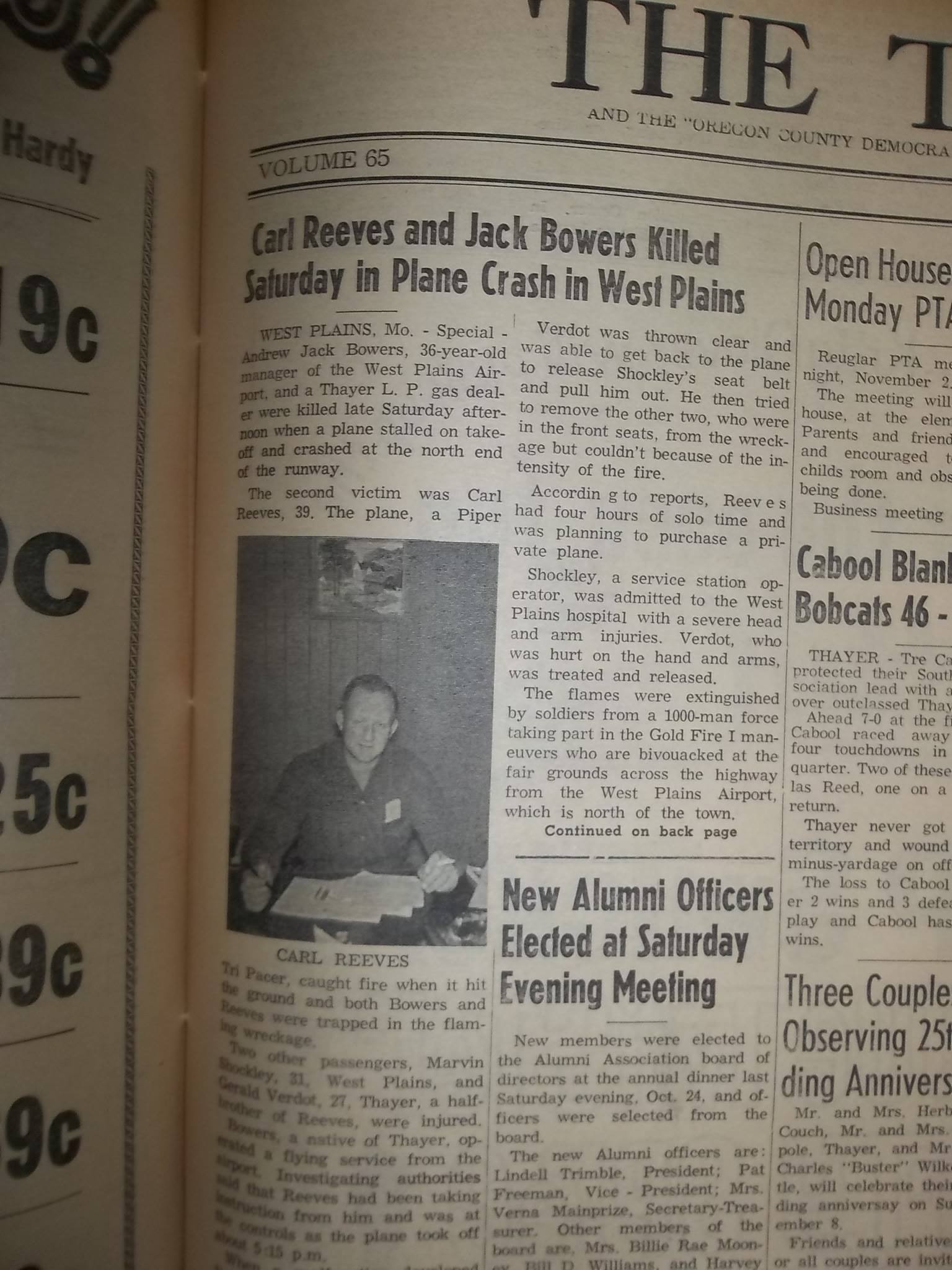
A Thayer newspaper report identifies Andrew Jack Bowers, 36, and Carl Reeves, 39, as killed when a Piper airplane stalled during takeoff and crashed at the north end of the West Plains airport runway. Marvin Shockley, 31, of West Plains and Gerald Verdot, 27, of Thayer survived with injuries. The report describes Verdot freeing Shockley and attempting to reach the front-seat occupants but being prevented by the fire.
Original newspaper report naming victims and survivors, including portrait of Carl Reeves · Original filename: 19xx Carl Reeves and Jack Bowers killed in Plane Crash.jpg
Historical photograph pending — original image file not yet available.
Burned aircraft wreckage shown in The Thayer News · Original filename: 1964 Reeves and Bowers killed in plane crash.jpg
The supplied newspaper image is dated October 30, 1964, and describes the crash as occurring the preceding Saturday.
Source: Original newspaper clippings from the historical collection.