← Connections 2

Peach Capital of the World

🍑 Peaches by the Numbers Estimates

Koshkonong, St. Elmo, Brandsville and the South Missouri peach-growing region

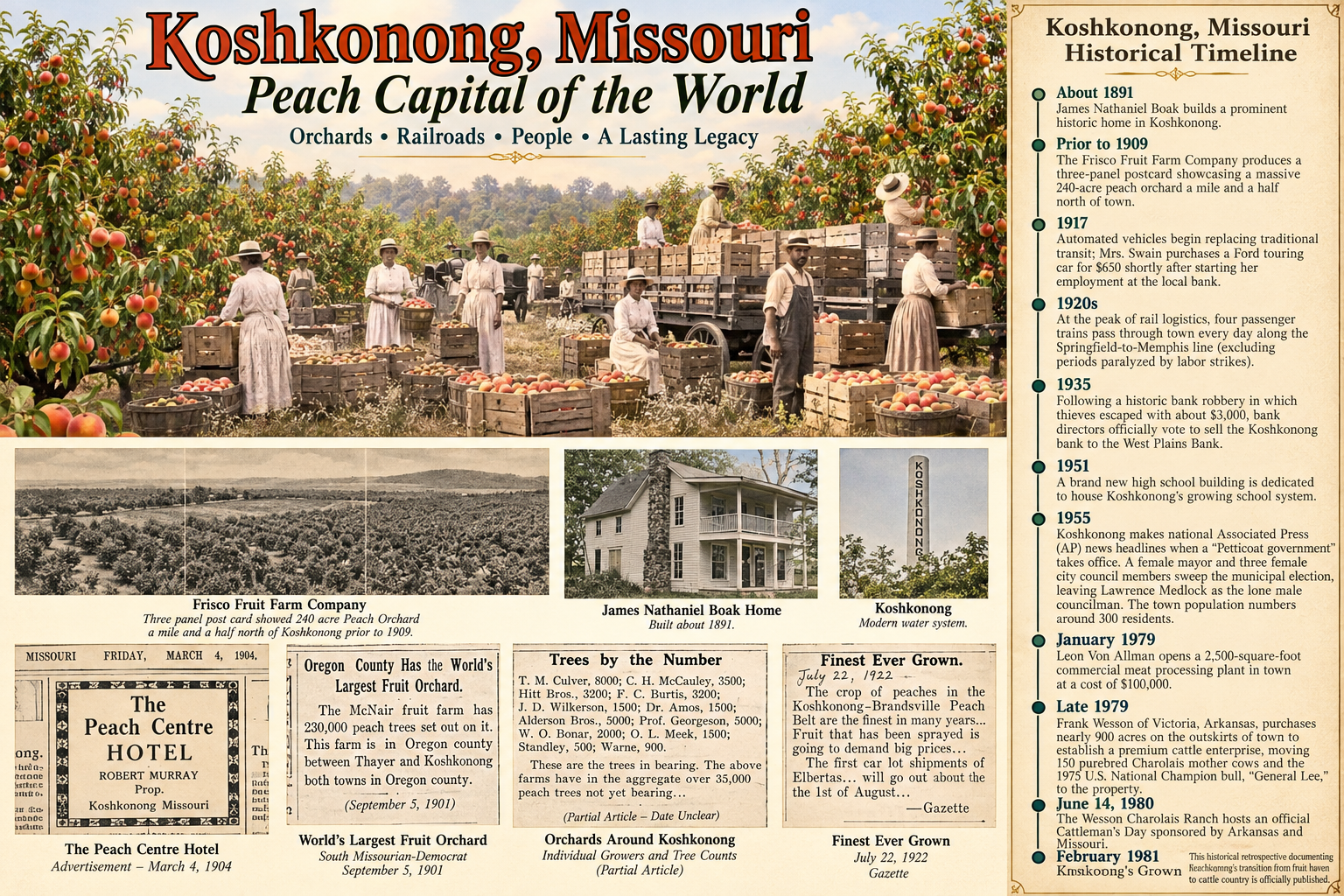
Illustrated Peach Capital of the World cover showing an orchard, historical clippings, and a Koshkonong timeline
Illustrated historical exhibit cover (modern artistic reconstruction; not an original historical photograph). Click to enlarge. Historical images and source documents appear below.
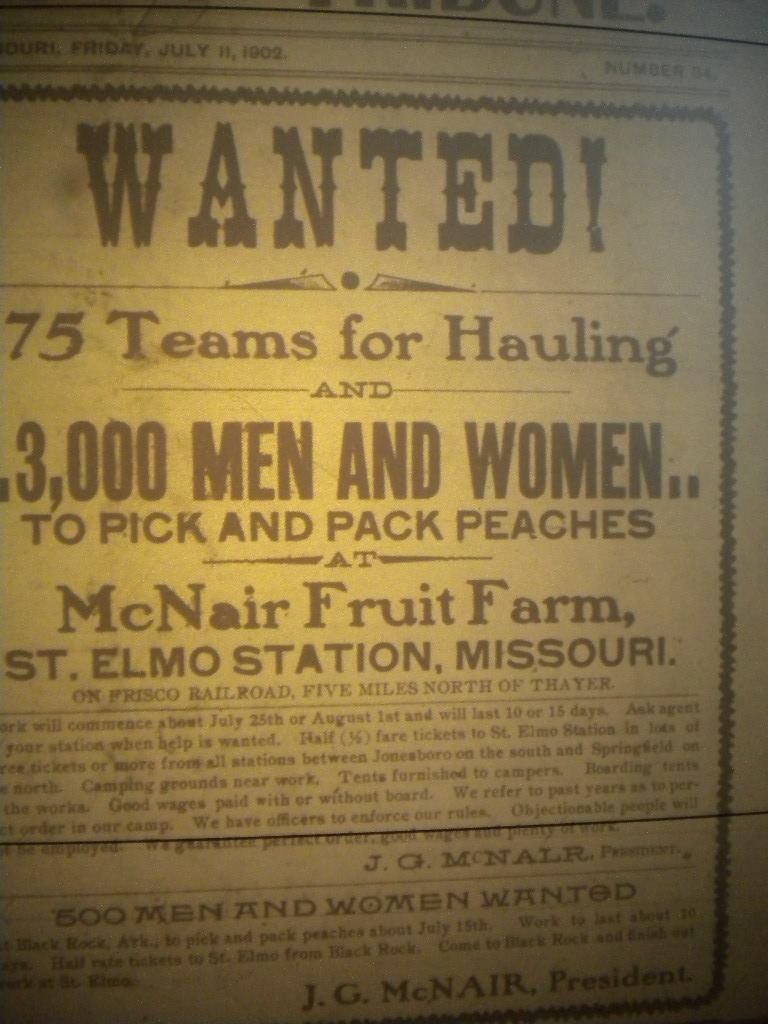
1902 advertisement seeking 3,000 workers at McNair Fruit Farm
1902: Wanted — 3,000 men and women to pick and pack peaches. McNair Fruit Farm, St. Elmo Station, Missouri. The advertisement also called for 75 hauling teams. This was a recruitment advertisement, not a verified count of workers actually employed.

The Peach Era in South Missouri — Max Evans

By Max Evans • Contributions by Shann Caldwell

South Maissouri, in Howell and Oregon Counties, became one of the largest peach producing areas in the U. S. in the early nineteen hundreds. Peaches, a short lived fruit off the tree, were prevalent in a strip with near proximity to the railroad from north of West Plains, near Pomona south to Thayer, Missouri.

So what happened to the large peach orchards in south Missouri and how did it lose its “Peach Capital’claim?

Beginning about 1900, peak production of the peach trees planted in South Missouri lasted about twenty-five years. It began to slow in the nineteen twenties and gradually diminished up through the nine-teen forties. The year of 1910 may have been the apex of the peach harvests and activity within the orchard regions. The ravages of weather (there were several late frosts in the teens, especially one at Easter in 1920), the vagaries of economics, labor availability, a railroad strike in July of 1922, farming in other states, and a freak hail storm in 1937 all contributed to the downward spiral of the large orchards with a big hit on labor during WW I and then the great depression in the nineteen thirties had a devastating effect. Many smaller orchards remained but the trees became less productive and competition from other parts of the country took over the market. Most family farms had small orchards but one of the last commercial growers of any size, the Campbell farm at Koshkonong, continued until the fifties. The older trees gradually became less productive and orchards resorted to “pick your own methods” Several growers and larger farms in the West Plains and Pomona area continued to produce after others quit but the train loads of peaches and large packing sheds were an item of history by 1950.

The movement to plant fruit trees in the Midwest began to take hold before the Civil War. According to newspaper ads, fruit tree and seed salesmen began to spread out into the midwest in the 1840’s but it was the advent and the construction of railroads in the late eighteen hundreds which made possible the large migration to the area and opened up the market for agriculture to the large population centers in the north and east.

Continue reading Max Evans’s article

The full article is preserved across these reading pages. Original source document is retained in the archive.

The Peach Era

At the turn of the twentieth century, orchards around Koshkonong, St. Elmo and Brandsville became a major center of Elberta peach production. Harvest crews picked fruit, workers packed it into boxes and baskets, and refrigerated Frisco railroad cars carried peaches to distant markets.

Historical newspaper reports describe the Koshkonong Fruit Company, McNair orchards, packing sheds, and large seasonal workforces. Figures vary by source and year; the original articles are preserved so readers can examine their claims.

Reviewed historical articles — original scans and readable text

Six reviewed article groups. The Queen Elberta article has three scans, shown as one article. Click any image to enlarge it. Transcriptions are provisional where scans are damaged.

Where Peaches Grow — June 9, 1904View pictures in the gallery

Where Peaches Grow — June 9, 1904 — scan 1
Original scan 1 of 1 — click to enlarge

Orchards are the commercial backbone of Southern Missouri. Thousands of acres have been set to fruit trees, each succeeding year adding many acres of orchards to those already bearing, and this year 1904 will be known as the greatest peach crop in the history of Missouri and Oregon, the greatest peach producing counties in the Ozark region. There have been planted for bearing over 315,000 peach trees. Of this number almost all are of the Elberta variety, which has proved to be the peach best adapted to the region, both for shipping, keeping and color. For preserving or any other purpose it possesses the natural flavor and when peaches from other sections are compared with it— [Further text is partly obscured in the original clipping; figures and wording require verification.]

Peach Picking Season — 1915 at Koshkonong (1965 retrospective)View pictures in the gallery

Peach Picking Season — 1915 at Koshkonong (1965 retrospective) — scan 1
Original scan 1 of 1 — click to enlarge

About the second week in August is the time the famous Elberta peaches are ready for harvest in Koshkonong. Years ago Koshkonong had thousands of acres of peaches and they were shipped in carloads to the big city markets. At present Aubrey Campbell has the only sizeable orchard at Koshkonong and the harvest is now on with a good crop and very nice peaches. In the old time picture above, made in 1915, a group of pickers is shown at the C. F. Tabler peach orchard. Those in the picture are identified as follows: FRONT: Fred Land, foreman; Dallas Huffman, Orel Huffman; Herbert Land, Manzora Huffman, Gene Holloway, Fred Holloway and Ben Huffman. Back row: Holloway, Allen Holloway, Bill Hurst, Will Hurst, Volmar Bull Hurst, Will Huffman, Charles Land, Bill Hammond, Elbert Huffman, George Huffman, Bassham, Lem Mackey, Bassham, Hammonds, Henry Holloway, Ellen Holloway, Ellen Huffman, A. J. Huffman. Sitting in wagon are Jack Cole and Alfred Huffman. Picture and identification was contributed by Mrs. S. M. Baker. [Both occurrences of Ellen reflect the contributor’s correction of the reading “Elee”; other names require review.]

In the Land of the Queen Elberta — three scans, one articleView pictures in the gallery

In the Land of the Queen Elberta — three scans, one article — scan 1
Original scan 1 of 3 — click to enlarge
In the Land of the Queen Elberta — three scans, one article — scan 2
Original scan 2 of 3 — click to enlarge
In the Land of the Queen Elberta — three scans, one article — scan 3
Original scan 3 of 3 — click to enlarge

The Great Peach Crop of Oregon County Makes This Section Famous — Nearly Half a Million Bearing Peach Trees — Acreage To Be Increased. Elberta, thou queen of a thousand hills! Resplendent in thy royal red and gold, More than a peer art thou of queens of old, Whose reigns too oft begot a myriad ills For those they loved. Thy royal largess fills The hands that toil with golden recompense, And thousands bless thy sweet beneficence. What goddess in thy radiant form distills The nectar, half divine, that doth impart That glorious blush unto thy sun-kiss'd cheek That rivals well the red blood of the heart Mingled with yellow gold that Arabs seek? Elberta, here's a thousand years to thee! Queen of the Ozarks shalt thou ever be! — OSCAR MACDONALD BROOKE. The period of questioning and doubt as to whether South Missouri is a successful fruit country is past. The great peach crop this year establishes the reputation of this section of the Ozarks as the greatest peach producing region in the United States. The day for cavil and uncertainty is numbered among the yesterdays. The comfort contained in this fact can only be realized to the full by those who have invested money in fruit farms here, who have cleared away the forests, planted out young trees and waited and toiled amid killing frosts, disappointments and discouragements; but with courage and fortitude bore with the hardships, suspense and worries in [text unclear]. [Continuation begins mid-sentence.] … and Hitt & Sons are situated, the packing is far from being completed. T. M. Culver's company has a young orchard still loaded with the big luscious Elberta. He is working about 300 hands yet and is shipping from four to six car loads daily. Up to the present he has shipped 50 car loads, and will have about 25 or 30 more. Hitt & Sons of the Lake Rowland farm shipped 14 cars, which they sold to a Chicago firm. O. L. Meek, who is a prosperous merchant as well as a successful fruit grower, shipped 6 cars. Craig & Wilkerson, who hold a lease on the Eglantine farm, sold 3 cars to McNair from it, while Mr. Craig who is manager of the Grand View farm sold from that 6 cars. Of the many other growers about Koshkonong, the majority either sold their crops in the field or picked and packed them in temporary sheds and sold to McNair, while a smaller number made shipments by express. Buyers were present from Chicago, Peoria, Cincinnati, Milwaukee, St. Paul and many other points, all eager to secure peach shipments, and [continuation unclear]. Whenever Koshkonong is mentioned, peaches are brought to mind. It is a peach town [comparison to Fort Valley, Georgia, partly unclear]. On the day of our visit fully 1,000 men, women and children were picking, packing and loading Elbertas. At the packing house of the Koshkonong Fruit Company, an association of growers, 100 were at work, mostly women and girls, while at McNair's [passage unclear]. [Remaining columns contain damage and are not represented as a complete transcription.]

Big Peach Crop at Kosh — continued articleView pictures in the gallery

Big Peach Crop at Kosh — continued article — scan 1
Original scan 1 of 2 — click to enlarge
Big Peach Crop at Kosh — continued article — scan 2
Original scan 2 of 2 — click to enlarge

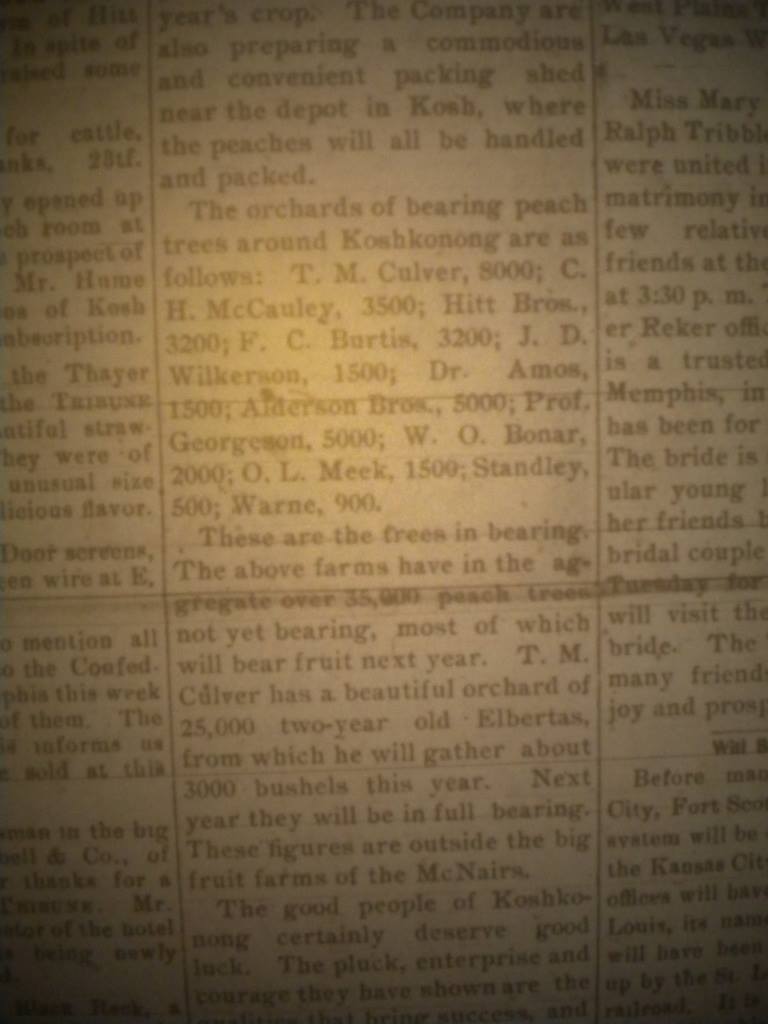
Thousands of Beautiful Trees Laden with the Luscious Elberta. A finer prospect for a mammoth crop of peaches never smiled from the big peach farms of Koshkonong than may be seen this year. We had the pleasure of viewing several of them a few days since, and the scene baffles description. Imagine thousands of acres of beautiful peach trees, every one like every other, and all of those in bearing laden with young peaches until the limbs already droop. The Koshkonong Fruit Company, composed of the principal fruit growers of the vicinity, placed an order Friday for $3000 worth of crates, which is estimated to be about one-third of the amount that will be required to pack the peaches from this year's crop. The Company are also preparing a commodious and convenient packing shed near the depot in Kosh, where the peaches will all be handled and packed. The orchards of bearing peach trees around Koshkonong are as follows: T. M. Culver, 8000; C. H. McCauley, 3500; Hitt Bros., 3200; F. C. Burtis, 3200; J. D. Wilkerson, 1500; Dr. Amos, 1500; Alderson Bros., 5000; Prof. Georgeson, 5000; W. O. Bonar, 2000; O. L. Meek, 1500; Standley, 500; Warne, 900. These are the trees in bearing. The above farms have in the aggregate over 35,000 peach trees not yet bearing, most of which will bear fruit next year. T. M. Culver has a beautiful orchard of 25,000 two-year old Elbertas, from which he will gather about 3000 bushels this year. Next year they will be in full bearing. These figures are outside the big fruit farms of the McNairs. The good people of Koshkonong certainly deserve good luck. The pluck, enterprise and courage they have shown are [clipping ends].

Peach Harvesting Time — Vester Williams, July 21, 1966View pictures in the gallery

Peach Harvesting Time — Vester Williams, July 21, 1966 — scan 1
Original scan 1 of 1 — click to enlarge

Full contributor-supplied transcription (uncertain or incomplete wording is indicated). Historical claims have not been independently verified. July 21, 1966 — THE SALEM HEADLIGHT — page 77 PEACH HARVESTING TIME... By Vester Williams From the early 1890's to the 1930's, great peach orchards covered the area surrounding the towns of Koshkonong and Brandsville, Missouri. These large orchards came up to the end of the streets in these two Missouri towns. Some of these orchards contained more than a thousand acres and comprised peach trees numbering into the millions. Most of the trees in the big orchards were of the Elberta variety, and would be ready to harvest anywhere from the 25th of July to the first of August. This was a period in which people converged on Koshkonong, and Brandsville from almost every state in the Union — some to work in the orchards and others to gamble and or participate in a variety of nefarious activities if they thought they could get by with it. But for the most part, the hands came from the Missouri-Arkansas Ozark region with a springling coming from Georgia and Tennessee. These hands had come for the needed money that could be made and in addition for the excitement of "roughing" it for ten or twelve days. They may at times have been disappointed in the amount of money they were able to make, but they were never disappointed in the "roughing" part of the deal. The land on which the orchards were located was rough; the roads were rough; the food for the most part was rough; the beds were hot and rough; the majority of the workers were rough, and the fuzz on the peaches made a worker's skin burn and feel rough. So there was no lack of roughness about the job of harvesting the bumper crops of peaches in those big commercial orchards. It would be unfair to not say that there was a great deal of fun mixed with the roughing. The predicaments some had the misfortune to fall into were hilarious to all but the unfortunate ones. There was not a person or an animal in the world that there was not someone in the crowd who could mimic or imitate his actions or his voice. Just how a person or an animal acted or sounded was always being demonstrated by some one. Everything—the food, the bed, the water and so on had a nickname. No one ever said, "Pass the beans or pass the bread." It was always shoot the beans; shoot the salt; shoot the moonshine (bread) and so on. Then too, there was now and then a peach battle at the packing shed at nights. These battles were generally painful and exciting. This writer remembers one in particular in which a gang from Arkansas started throwing cull peaches at one another one night. As the battle grew hot some of the boys ran to the opposite side of the shed for protection. This maneuver set up a fire across the shed which resulted in a bunch of Georgia packers being hit while they were working at the packing tables. Some of the Georgia fellows became somewhat boastful and threatening. A voice a way back in the dark yelled, "Turn the artillery on them!" Then a big rock the size of a baseball hit a plank nailed above the packing tables. That quieted the Georgians. They tried to get some of the Missouri boys to go into town, which was four miles away and get an officer of the law out there, but the Missouri boys refused. The Missouri people were not happy about the Georgians being there and being given the best paying and the easiest jobs. They contended that there were plenty of skilled home-labor to pack all the peaches that would be harvested there. They were in hopes that, the war would cause the Georgians to evacuate the fort. It was a good thing for the Arkansas boys that there were no telephone; if there had been, half of the young manhood in Fulton County would have been in jail next morning. Of course, this was an isolated case, and very few like it ever took place. I tell this to show the youth of today something about what was meant by roughing it back in the old days. The group shown in the accompanying picture with this sketch are a typical Fulton County group from up around Moko and along the Missouri line who always tried to make the fruit harvest at Koshkonong. Their first reason for going was to try to earn some needed money, and a second reason for going was for the excitement of roughing it for a few days. As we have already told you, this is a typical group of Fulton County men who made the fruit harvest. Among them is E. H. LaMore, then a boy of fourteen years. Mr. LaMore was a little orphan boy, who had his heart set upon obtaining an education. No doubt, some of his earnings went into school books and clothing for school. Today he is one of the best educated men in Fulton County. His success as a teacher and a lawyer need no pointing out, for his ability in both fields are well known to just about everyone living in this part of the state. Jesse and [crossed-out/unclear passage] Henry Skaggs have both been enterprising and useful men in their communities and in Salem at this time. Mr. Floyd is counted among our most progressive and useful citizens. Miser Emery, now deceased, was counted among our most progressive citizens at the time of his death. I am not personally acquainted with several of the men in this group, but I know something about their family activities, and so far as I have been able to learn, there is not a man in this group that has not left something to posterity worth of emulation.

St. Elmo Fruit Farm and the McNair Orchards — historical accountView pictures in the gallery

St. Elmo Fruit Farm and the McNair Orchards — historical account — scan 1
Original scan 1 of 1 — click to enlarge

[Page begins in the middle of a longer account.] Farm which had 218 acres and several smaller growers helped swell the rail shipments out of West Plains. The 1910 Census listed Howell County with 474,000 apple trees and 424,269 peach trees. Oregon County, at that time, had 92,133 apple trees and 463,609 peach trees. One mile south of Koshkonong and five miles north of the railroad terminal at Thayer, was the St. Elmo Fruit Farm. It became the largest peach orchard in Missouri. It was established and planted in 1893 by the United Orchard Company, a corporation headed by John G. McNair — President and General Manager of St. Louis and capitalized at $1,500,000. Officers in the company were; Lilburn G. McNair — Vice President, Fletcher Harris — Treasurer, Laurence W. Day, Secretary. Directors of the United Orchard Company were James W. Bell, Director of Mercantile Trust, Lilburn G. McNair — President of Interstate Transit, John E. Pilcher — 1st Vice Pres. of Simmons Hardware Company, Chas. H. Beggs — Vice Pres. and Assistant General Manager of the St. Louis, San-Francisco Railroad, Fletcher Harris — VP of McNair, Harris and Jones, Walter J. McBride — 1st VP and Gen. Mgr. of American Car and Foundry Company, Lourance O. Branch — President White-Branch-McConin-Sutton Hat Company, Walter Woodward — General Manager of Woodward Tillman Printing Co. United Orchard Company offices were at 518 Century Building, St. Louis, MO. With orchards in Missouri, Illinois, Arkansas, Georgia, Alabama and Texas, they advertised heavily for investors to further develop 10,000 acres of fruit orchards in the six states. They planned to eventually have 1,026,746 trees in cultivation and were acknowledged by many to be the most successful fruit growers in the world. The St. Elmo orchard, starting with 400 acres in 1898 was probably named by Mrs. Orthwein McNair, one of the promoters and the wife of John G. McNair's brother. Mrs. Orthwein McNair was a great literary reader and “St. Elmo” a book, written in 1866, by Janes Evans Wilson, was very popular at that time and had a railroad accident as one of the central incidents in the story, lending credence to this belief. John G. McNair and his brother Orthwein were the grandson's of Alexander McNair (1775–1826), the first Governor of Missouri in 1820. The St. Elmo Fruit Farm covered 2,242 acres. It was in full production in 1901 with over 60,000 bearing trees after planting 40,500 during 1893 and 1894 and employing around 100 teams of horses and crews to clear and cultivate the land. By 1904, St. Elmo fruit farm had 103,000 bearing peach trees, 20,000 apple trees and 300 pear trees from a total of 230,000 trees, nearly all of them the Elberta variety. Also, large crops of strawberries were planted between the trees. Mr. McNair's company was the leading peach producer in the U. S. He had interests in several states, including Iowa and eventually spread out in a big way to Texas and Georgia. At one time he and his family wintered at Brownsville, Texas while increasing the size of his [page ends mid-sentence].

Original clippings with searchable text

Each scan is displayed beside its own draft text. Newspaper column boundaries and damaged print can cause mistakes; these are not certified transcriptions. The untouched original files are retained in the archive.

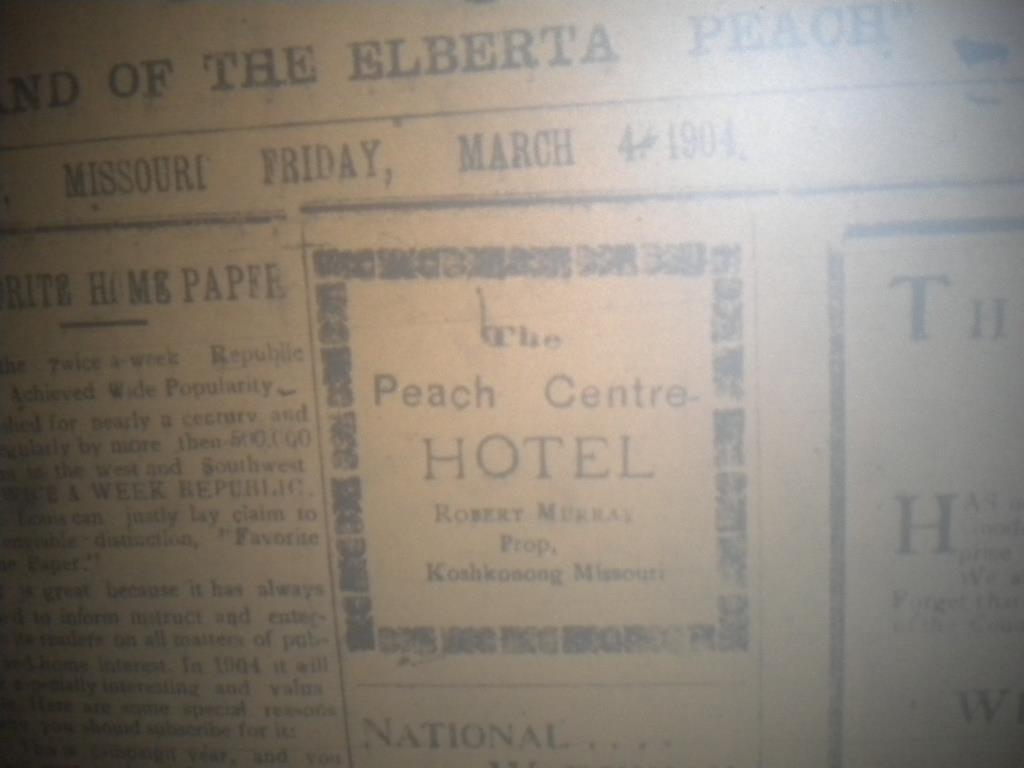
Peach Centre Hotel — March 4, 1904

Peach Centre Hotel — March 4, 1904
Original historical clipping — click to enlarge

The Peach Centre HOTEL ROBERT MURRAY, Prop. Koshkonong, Missouri

Oregon County Has the World’s Largest Fruit Orchard — September 5, 1901

Oregon County Has the World’s Largest Fruit Orchard — September 5, 1901
Original historical clipping — click to enlarge

Oregon County Has the World's Largest Fruit Orchard.

The McNair fruit farm has 230,000 peach trees set out on it. This farm is in Oregon county between Thayer and Koshkonong both towns in Oregon county.

Last Sunday's Republic in speaking of this world beater orchard, said:

“At the McNair farm, near Thayer, a few days ago over 8,000,000 peaches were handled three times before they left the station for the distant markets. This seems like an incredible amount of work, but 750 pickers can gather and pack a large quantity of fruit.

“On that day McNair loaded 20 cars with peaches. The fruit is so large that only 25 peaches are put into each basket.

“At dinner that day 450 pickers sat down to one table. The work is conducted with perfect system and almost military strictness regulates the conduct of the little army of hands.

“The peach harvest is moving up the slope of the Ozarks. The season down on the state line is about two weeks ahead of the summit of the mountains at Cedar Gap. From Cedar Gap the passengers on the trains look out upon a scene of rare beauty. The mountain sides south of the railroad have of late years become fruitful orchards and millions of big peaches now blush in the August sun on the very tops of the bald peaks that bestud the White river side or the Ozark watershed. On the north side of the track the smoky crests of the Gasconade hills are likewise covered with peach orchards, and as far as the eye can reach in any direction the busy workers are seen gathering the beautiful harvest.

“Mrs. E. J. Perry and Mrs. Ed Mann and some other Springfield people made a visit down to the McNair fruit farm a few days ago and they came back home delighted with the wonders they had seen in Missouri's mammoth peach orchard...”

Read the history: newspaper text and research notes

Some original clippings are difficult to read. These accessible summaries report what the sources say; they are not word-for-word transcriptions. The original images and source documents remain available for checking dates, names, and wording.

1902 — McNair Fruit Farm seeks harvest workers

A July 11, 1902 advertisement for McNair Fruit Farm at St. Elmo Station called for 75 hauling teams and 3,000 men and women to pick and pack peaches. It advertised the farm as five miles north of Thayer on the Frisco Railroad. These were positions sought in the advertisement, not a verified number hired.

1904 — The Missouri Peach Belt

Will H. Zorn's article, “The Missouri Peach Belt,” in Frisco System Magazine describes the Elberta peach industry and Koshkonong as the southern end of the peach belt. It explains that pickers and packers moved northward as the fruit ripened, and that refrigerated rail cars carried the harvest to distant markets. The continuation reports that St. Elmo Fruit Farm covered 2,242 acres and had 103,000 bearing peach trees, 20,000 apple trees, and 300 pear trees. It states that at least 1,000 laborers were needed to gather and market a full crop on that farm. These are period-published figures.

1915 — Peach Picking Season at Koshkonong

A newspaper article published in August 1965 recalls the 1915 peach-picking season in Koshkonong and reproduces a group photograph. It describes the busy harvest season, the use of refrigerated cars, and the importance of peach growing to the community. The accompanying names and the photograph should be reviewed against the original clipping before individual identifications are added to the people directory.

Peach packing and the railroad

The Frisco article describes wagons hauling harvested fruit to packing sheds, where peaches were sorted and packed into boxes and baskets. It describes the work of women and girls as packers, and explains the importance of consistent sizing and careful handling to prevent bruising during rail shipment. Its historical wage figures are source claims, not modern equivalents.

Economic change in Oregon County

A later research summary connects the rise of peach orchards with railroad shipping, packing work, seasonal migration and canneries, alongside the county's earlier lumbering economy. This is a secondary summary, distinct from contemporary newspaper and railroad-magazine reports. Some footnote references in that summary are incomplete and require further source checking.

Source documents: Open source PDF in browser · Open source PDF in browser · Economic shifts research summary (Word document).

We preserve the original clippings, including faded or incomplete text. Where a full transcription is uncertain, we provide a clearly labeled readable summary instead of guessing missing words.

Frisco System Magazine — browse pages

Read the original magazine pages on this website. Use Previous and Next to turn pages. The readable text alongside each scan comes from the source PDF and may contain scanning errors; check names and numbers against the original.

Frisco System Magazine — The Missouri Peach Belt

Frisco System Magazine — The Missouri Peach Belt scanned page
Open original PDF in browser

Frisco System Magazine — St. Elmo and regional orchards

Frisco System Magazine — St. Elmo and regional orchards scanned page
Open original PDF in browser

Historical photograph and clipping gallery

Start with “Where Peaches Grow” (June 9, 1904): click its thumbnail, then click the large image again to open the full-size scan. Scroll inside the enlarged view to read the original printing. The original image is 686 × 1078 pixels, so enlargement cannot recover detail that was not captured in the scan.

Browse all available images below. Select any item for a larger view, then use Previous, Next, Back to Gallery or keyboard arrow keys. Some items are alternate photographs of the same newspaper clipping; original filenames are preserved.

Select a newspaper picture to read its available transcription. Use “Read article beside original scans” to open the full reading panel. Damaged or missing passages remain identified.

Oregon — County Profile and Agricultural Statistics

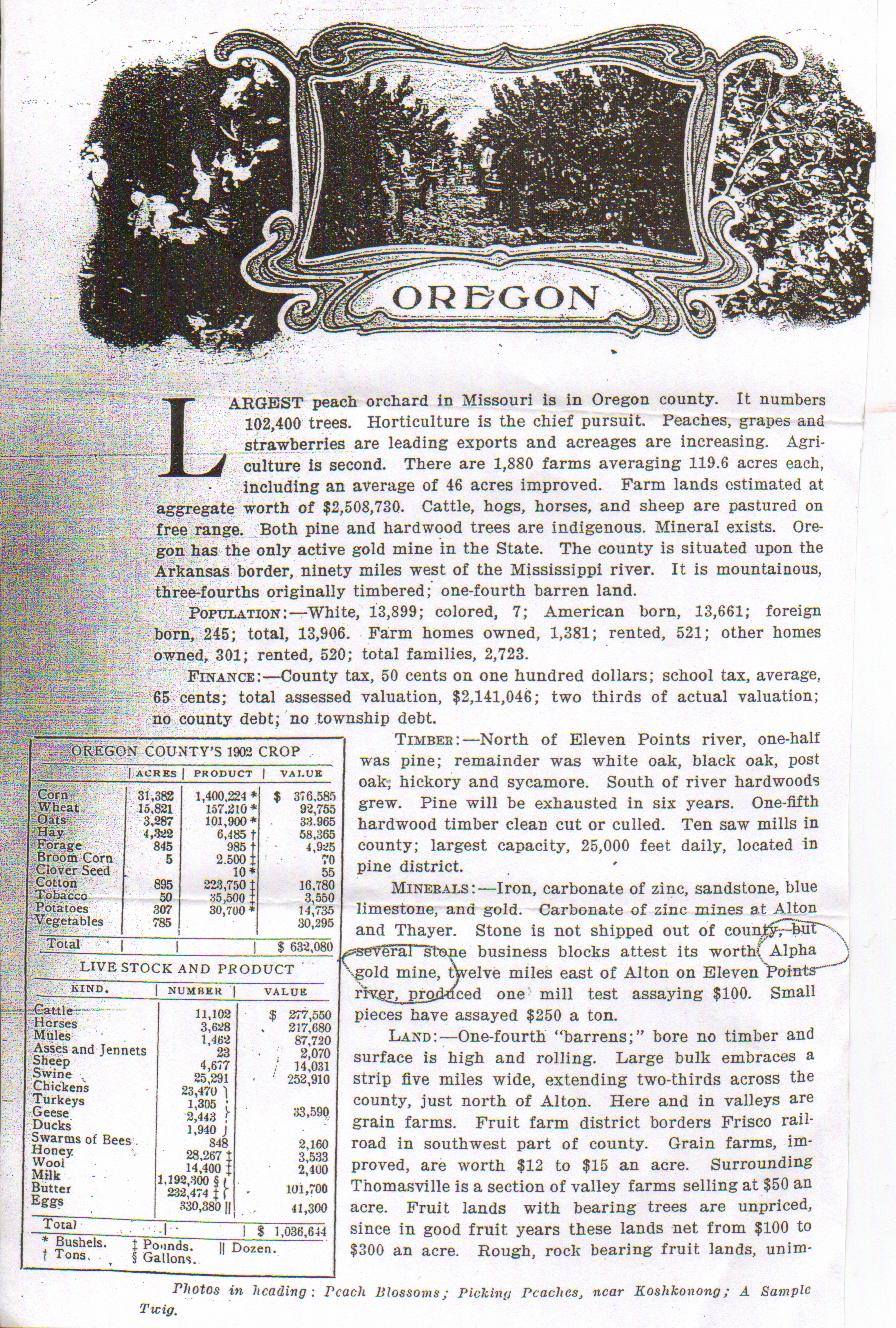
Historical source page. The text below transcribes the main narrative. The two statistical tables are preserved in the original scan for accurate reading; their small figures still need line-by-line verification before a full numerical transcription can be claimed.

Original Oregon County agricultural profile, including crop and livestock tables
Open the original scan at full size to examine the crop and livestock tables.

OREGON

LARGEST peach orchard in Missouri is in Oregon county. It numbers 102,400 trees. Horticulture is the chief pursuit. Peaches, grapes and strawberries are leading exports and acreage are increasing. Agriculture is second. There are 1,880 farms averaging 119.6 acres each, including an average of 46 acres improved. Farm lands estimated at aggregate worth of $2,508,730. Cattle, hogs, horses, and sheep are pastured on free range. Both pine and hardwood trees are indigenous. Mineral exists. Oregon has the only active gold mine in the State. The county is situated upon the Arkansas border, ninety miles west of the Mississippi river. It is mountainous, three-fourths originally timbered; one-fourth barren land.

POPULATION—White, 13,899; colored, 7; American born, 13,661; foreign born, 245; total, 13,906. Farm homes owned, 1,281; rented, 521; other homes owned, 301; rented, 520; total families, 2,723.

FINANCE—County tax, 50 cents on one hundred dollars; school tax, average, 65 cents; total assessed valuation, $2,141,046; two thirds of actual valuation; no county debt; no township debt.

TIMBER—North of Eleven Points river, one-half was pine; remainder was white oak, black oak, post oak, hickory and sycamore. South of river hardwoods grew. Pine will be exhausted in six years. One-fifth hardwood timber clean cut or culled. Ten saw mills in county; largest capacity, 25,000 feet daily, located in pine district.

MINERALS—Iron, carbonate of zinc, sandstone, alum limestone, and gold. Carbonate of zinc mines at Alton and Thayer. Stone is not shipped out of county, but several stone business blocks attest its worth. Alpha gold mine, twelve miles east of Alton on Eleven Points river, produced ore mill test assaying $100. Small pieces have assayed $250 a ton.

LAND—One-fourth “barrens,” bore no timber and surface is high and rolling. Large bulk embraces a strip five miles wide, extending two-thirds across the county, just north of Alton. Here and in valleys are grain farms. Fruit farm district borders Frisco railroad in southwest part of county. Grain farms, improved, are worth $12 to $15 an acre. Surrounding Thomasville is a section of valley farms selling at $50 an acre. Fruit lands with bearing trees are unpriced, since in good fruit years these lands net from $100 to $300 an acre. Rough, rock bearing fruit lands, unimproved, [continues beyond visible image].

Some letters and figures in this scan are difficult to distinguish. The printed crop and livestock tables remain visible in the original image, but have not been independently verified as searchable text.

Historical articles and source documents

Open source PDF in browser. It describes the St. Elmo orchards, packing sheds, wages, transportation, and other fruit farms in the region.

Read the collected Kosh Peach Stories and recollections (RTF), including comments attributed to Max H. Evans. These personal recollections are presented as attributed testimony, not independently verified facts.

Several original newspaper clippings are faded or incomplete. Their images are retained, and readable text can be added with uncertain words marked rather than guessed. Dates and attributions remain subject to verification.

Read the Historical Newspaper Clippings

Original scans are shown beside readable text from the submitted conversions. Some passages are summarized or partial and are labeled as such. Click any image to enlarge it.

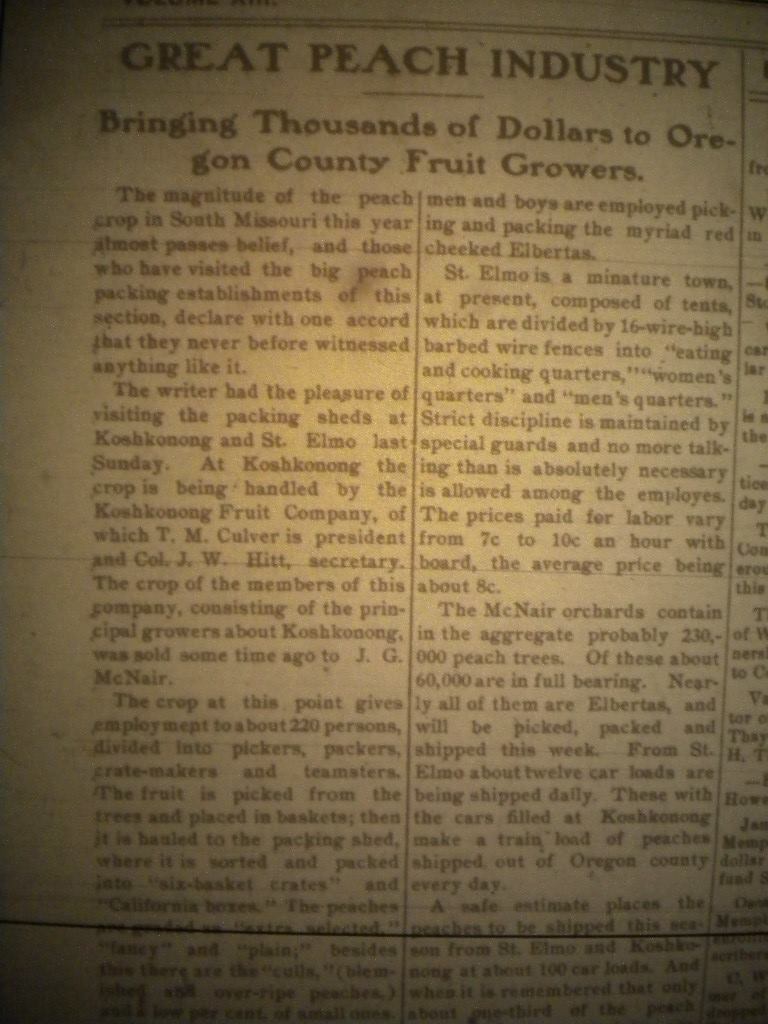
Great Peach Industry — Bringing Thousands of Dollars to Oregon County Fruit Growers

Original scan: Great Peach Industry — Bringing Thousands of Dollars to Oregon County Fruit Growers
Click the original scan to enlarge

GREAT PEACH INDUSTRY Bringing Thousands of Dollars to Oregon County Fruit Growers.

The magnitude of the peach crop in South Missouri this year almost passes belief, and those who have visited the big peach packing establishments of this section, declare with one accord that they never before witnessed anything like it.

The writer had the pleasure of visiting the packing sheds at Koshkonong and St. Elmo last Sunday. At Koshkonong the crop is being handled by the Koshkonong Fruit Company, of which T. M. Culver is president and Col. J. W. Hitt, secretary. The crop of the members of this company, consisting of the principal growers about Koshkonong, was sold some time ago to J. G. McNair.

The crop at this point gives employment to about 220 persons, divided into pickers, packers, crate-makers and teamsters. The fruit is picked from the trees and placed in baskets; then it is hauled to the packing shed, where it is sorted and packed into “six-basket crates” and “California boxes.” The peaches are graded as “extra selected,” “fancy” and “plain;” besides this there are the “culls,” (blemished and over-ripe peaches,) and a low per cent. of small ones. Men and boys are employed picking and packing the myriad red cheeked Elbertas.

St. Elmo is a minature town, at present, composed of tents, which are divided by 16-wire-high barbed wire fences into “eating and cooking quarters,” “women's quarters” and “men's quarters.” Strict discipline is maintained by special guards and no more talking than is absolutely necessary is allowed among the employes. The prices paid for labor vary from 7c to 10c an hour with board, the average price being about 8c.

The McNair orchards contain in the aggregate probably 230,000 peach trees. Of these about 60,000 are in full bearing. Nearly all of them are Elbertas, and will be picked, packed and shipped this week. From St. Elmo about twelve car loads are being shipped daily. These with the cars filled at Koshkonong make a train load of peaches shipped out of Oregon county every day.

A safe estimate places the peaches to be shipped this season from St. Elmo and Koshkonong at about 100 car loads. And when it is remembered that only about one-third of the peach [article continues beyond clipping].

Oregon County — Historical County Profile

Original scan: Oregon County — Historical County Profile
Click the original scan to enlarge

Full contributor-supplied transcription (uncertain or incomplete wording is indicated). Historical claims have not been independently verified.

OREGON — County profile (1902 crop figures)

Largest peach orchard in Missouri is in Oregon county. It numbers 102,400 trees. Horticulture is the chief pursuit. Peaches, grapes and strawberries are leading exports and acreages are increasing. Agriculture is second. There are 1,880 farms averaging 119.6 acres each, including an average of 46 acres improved. Farm lands estimated at aggregate worth of $2,508,730. Cattle, hogs, horses, and sheep are pastured on free range. Both pine and hardwood trees are indigenous. Mineral exists. Oregon has the only active gold mine in the State. The county is situated upon the Arkansas border, ninety miles west of the Mississippi river. It is mountainous, three-fourths originally timbered; one-fourth barren land.

POPULATION: White, 13,899; colored, 7; American born, 13,661; foreign born, 245; total, 13,906. Farm homes owned, 1,381; rented, 521; other homes owned, 301; rented, 520; total families, 2,723.

FINANCE: County tax, 50 cents on one hundred dollars; school tax, average, 65 cents; total assessed valuation, $2,141,046; two thirds of actual valuation; no county debt; no township debt.

OREGON COUNTY'S 1902 CROP (Acres | Product | Value): Corn | 31,882 | 1,400,224 bushels | $376,585 Wheat | 15,821 | 157,210 bushels | $92,755 Oats | 3,287 | 101,900 bushels | $33,965 Hay | 4,322 | 6,485 tons | $58,365 Forage | 845 | 985 tons | $4,925 Broom Corn | 5 | 2,500 pounds | $70 Clover Seed | [blank] | 10 bushels | $55 Cotton | 895 | 223,750 pounds | $16,780 Tobacco | 50 | 35,500 pounds | $3,550 Potatoes | 307 | 30,700 bushels | $14,735 Vegetables | 785 | [blank] | $30,295 Total | | | $632,080

LIVE STOCK AND PRODUCT (Number | Value): Cattle | 11,102 | $277,550 Horses | 3,628 | $217,680 Mules | 1,462 | $87,720 Asses and Jennets | 23 | $2,070 Sheep | 4,677 | $14,031 Swine | 25,291 | $252,910 Chickens | 23,470 | [included in poultry] Turkeys | 1,305 | [included in poultry] Geese | 2,443 | $33,590 [poultry group] Ducks | 1,940 | [included in poultry] Swarms of Bees | 848 | $2,160 Honey | 28,267 pounds | $3,533 Wool | 14,400 pounds | $2,400 Milk | 1,192,300 gallons | [blank] Butter | 232,474 pounds | $101,700 Eggs | 330,380 dozen | [blank] Total | | $1,036,644

TIMBER: North of Eleven Points river, one-half was pine; remainder was white oak, black oak, post oak, hickory and sycamore. South of river hardwoods grew. Pine will be exhausted in six years. One-fifth hardwood timber clean cut or culled. Ten saw mills in county; largest capacity, 25,000 feet daily, located in pine district.

MINERALS: Iron, carbonate of zinc, sandstone, blue limestone, and gold. Carbonate of zinc mines at Alton and Thayer. Stone is not shipped out of county, but several stone business blocks attest its worth. Alpha gold mine, twelve miles east of Alton on Eleven Points river, produced one mill test assaying $100. Small pieces have assayed $250 a ton.

LAND: One-fourth "barrens;" bore no timber and surface is high and rolling. Large bulk embraces a strip five miles wide, extending two-thirds across the county, just north of Alton. Here and in valleys are grain farms. Fruit farm district borders Frisco railroad in southwest part of county. Grain farms, improved, are worth $12 to $15 an acre. Surrounding Thomasville is a section of valley farms selling at $50 an acre. Fruit lands with bearing trees are unpriced, since in good fruit years these lands net from $100 to $300 an acre. [Page continues.]

Photo caption: Peach Blossoms; Picking Peaches, near Koshkonong; A Sample Twig.
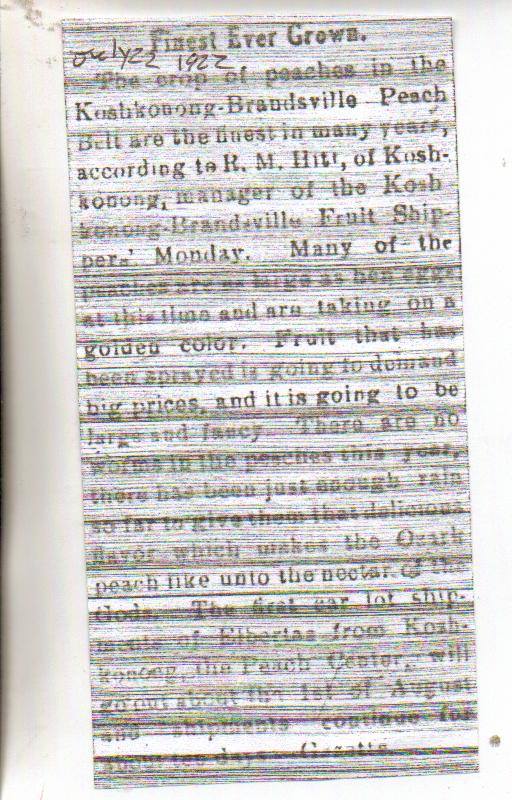
Finest Ever Grown — July 22, 1922

Original scan: Finest Ever Grown — July 22, 1922
Click the original scan to enlarge

Finest Ever Grown.

The crop of peaches in the Koshkonong-Brandsville Peach Belt are the finest in many years, according to R. M. Hitt, of Koshkonong, manager of the Koshkonong-Brandsville Fruit Shippers' [unclear] Monday. Many of the peaches are as huge as hen eggs at this time and are taking on a golden color. Fruit that has been sprayed is going to demand big prices, and it is going to be large and fancy. There are no worms in the peaches this year, there has been just enough rain so far to give them that delicious flavor which makes the Ozark peach like unto the nectar of the Gods. The first car lot shipments of Elbertas from Koshkonong, the Peach Center, will go out about the 1st of August and shipments continue for about ten days. — Gazette.

[Date handwritten on clipping: July 22, 1922; verify against original publication.]

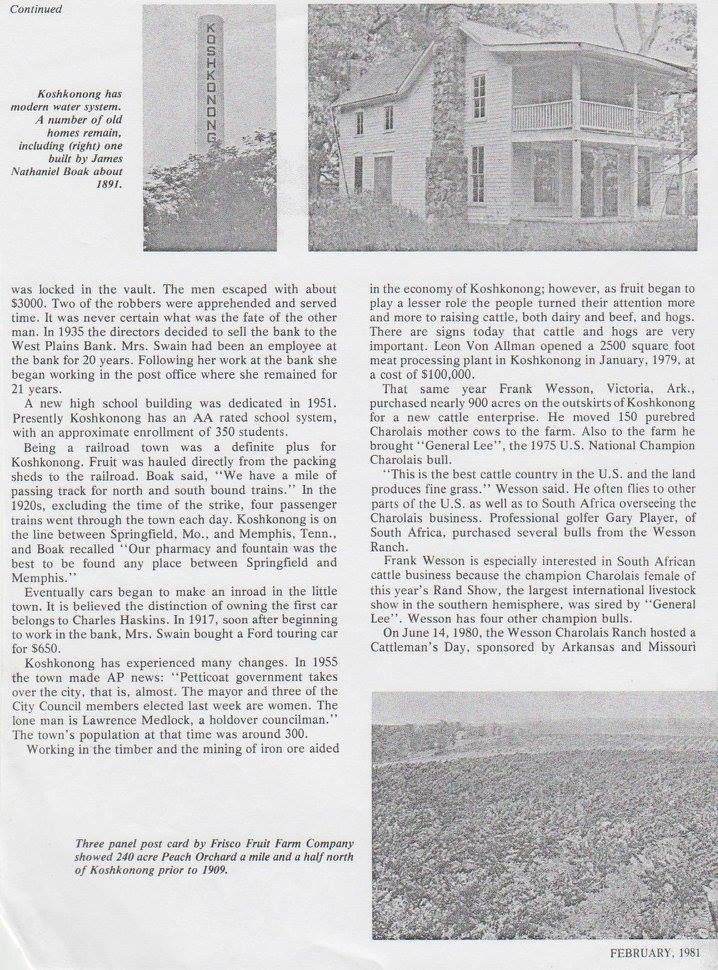
Koshkonong History — February 1981 Continuation — View picture in gallery

Original scan: Koshkonong History — February 1981 Continuation
Click the original scan to enlarge

Full contributor-supplied transcription (uncertain or incomplete wording is indicated). Historical claims have not been independently verified.

Koshkonong historical retrospective — February 1981 (continuation)

Image captions: Koshkonong has modern water system. A number of old homes remain, including (right) one built by James Nathaniel Boak about 1891.

was locked in the vault. The men escaped with about $3000. Two of the robbers were apprehended and served time. It was never certain what was the fate of the other man. In 1935 the directors decided to sell the bank to the West Plains Bank. Mrs. Swain had been an employee at the bank for 20 years. Following her work at the bank she began working in the post office where she remained for 21 years.

A new high school building was dedicated in 1951. Presently Koshkonong has an AA rated school system, with an approximate enrollment of 350 students.

Being a railroad town was a definite plus for Koshkonong. Fruit was hauled directly from the packing sheds to the railroad. Boak said, "We have a mile of passing track for north and south bound trains." In the 1920s, excluding the time of the strike, four passenger trains went through the town each day. Koshkonong is on the line between Springfield, Mo., and Memphis, Tenn., and Boak recalled "Our pharmacy and fountain was the best to be found any place between Springfield and Memphis."

Eventually cars began to make an inroad in the little town. It is believed the distinction of owning the first car belongs to Charles Haskins. In 1917, soon after beginning to work in the bank, Mrs. Swain bought a Ford touring car for $650.

Koshkonong has experienced many changes. In 1955 the town made AP news: "Petticoat government takes over the city, that is, almost. The mayor and three of the City Council members elected last week are women. The lone man is Lawrence Medlock, a holdover councilman." The town's population at that time was around 300.

Working in the timber and the mining of iron ore aided in the economy of Koshkonong; however, as fruit began to play a lesser role the people turned their attention more and more to raising cattle, both dairy and beef, and hogs. There are signs today that cattle and hogs are very important. Leon Von Allman opened a 2500 square foot meat processing plant in Koshkonong in January, 1979, at a cost of $100,000.

That same year Frank Wesson, Victoria, Ark., purchased nearly 900 acres on the outskirts of Koshkonong for a new cattle enterprise. He moved 150 purebred Charolais mother cows to the farm. Also to the farm he brought "General Lee", the 1975 U.S. National Champion Charolais bull.

"This is the best cattle country in the U.S. and the land produces fine grass," Wesson said. He often flies to other parts of the U.S. as well as to South Africa overseeing the Charolais business. Professional golfer Gary Player, of South Africa, purchased several bulls from the Wesson Ranch.

Frank Wesson is especially interested in South African cattle business because the champion Charolais female of this year's Rand Show, the largest international livestock show in the southern hemisphere, was sired by "General Lee". Wesson has four other champion bulls.

On June 14, 1980, the Wesson Charolais Ranch hosted a Cattleman's Day, sponsored by Arkansas and Missouri [continuation missing].

Image caption: Three panel post card by Frisco Fruit Farm Company showed 240 acre Peach Orchard a mile and a half north of Koshkonong prior to 1909.

Peaches by the Numbers Estimates

Financial impact of the Koshkonong peach industry. This research feature brings together figures reported in historical accounts and calculations based on stated assumptions. Estimates are not verified receipts, payroll records, or actual profits.

Trees by the number — bearing trees of local independent growers

GrowerBearing peach trees
T. M. Culver8,000
Alderson Bros.5,000
Prof. Georgeson5,000
C. H. McCauley3,500
Hitt Bros.3,200
F. C. Burtis3,200
W. O. Bonar2,000
J. D. Wilkerson1,500
Dr. Amos1,500
O. L. Meek1,500
Warne900
Standley500
Total35,800

Future expansion: young trees

Local growers reportedly had more than 35,000 additional non-bearing trees. T. M. Culver's investment included 25,000 two-year-old Elberta trees, with an early harvest reported at approximately 3,000 bushels. The young trees should not be counted as already bearing.

Independent growers and the McNair orchards

MeasureIndependent growersMcNair orchards
Bearing trees reported35,80060,000
Approximate total trees, including young trees70,800+230,000

The McNair figures reflect historical reports from different years or stages of orchard development; they should not be treated as a same-day census. The independent total of 70,800 is a minimum approximation because the source says over 35,000 young trees.

Orchard land values and estimated annual returns

Historical descriptions placed ordinary improved grain land at $12–$15 per acre and some valley farms at $50 per acre. Bearing fruit land was described as capable of netting $100–$300 per acre in good fruit years; that is a reported potential, not an appraisal or guaranteed return.

Using an illustrative density of 100 trees per acre gives about 708 acres for 70,800 independent trees (about 358 bearing acres) and 2,300 acres for 230,000 McNair trees (about 600 bearing acres if 60,000 were bearing).

GroupIllustrative bearing acreageEstimated peak-year annual net potential
Independent growers358$35,800–$107,400
McNair orchards600$60,000–$180,000

Calculation: bearing acres × $100–$300 per acre. These are scenario estimates, not documented earnings. The density assumption is illustrative and does not establish the actual acreage of either operation.

Harvest and shipping volume

Culver's young orchard was credited with approximately 3,000 bushels in an early harvest. An account of the McNair operation describes as many as 8 million individual peaches in a day. At an illustrative 25 peaches per basket, that would equal 320,000 baskets. The basket conversion is arithmetic, not a verified shipment count; actual basket sizes and packing practices varied.

Seasonal labor and estimated payroll

The McNair operation reportedly employed 750 hand-pickers. Wage figures in the research range from 7¢ to 10¢ per hour. Using an assumed 8¢ per hour and a 10-hour day gives 80¢ per worker per day and a hypothetical $600 daily payroll for 750 workers.

For approximately 220 local workers in picking, packing, crate-making and hauling, the same assumed rate and shift yield an illustrative $176 daily payroll. These calculations do not establish the actual wages, hours, number of workers on a given day, or cash paid after any board arrangements.

St. Elmo tent town and operating costs

Historical accounts describe temporary worker housing, meals or board, separated quarters, fencing, and guards at the St. Elmo camp. Such facilities and supervision represented operating demands, but no reliable dollar total for those overhead costs is established by the supplied figures.

Source note: Prepared from the contributor's “Peaches by the Numbers” research summary and historical newspaper transcriptions. Orchard counts and contemporary descriptions are source-reported; acreage, basket equivalents, potential returns and payroll amounts are explicitly labeled estimates. Further verification against original newspaper scans is welcome.